The Impact of New Federal Reserve Policies on Gold Prices in 2026 (RECENT UPDATES)
The financial world is a complex tapestry woven with threads of economic indicators, geopolitical events, and, perhaps most influentially, the decisions made by central banks. Among these, the Federal Reserve stands as a colossus, its monetary policy decisions reverberating across global markets. As we look towards 2026, understanding the anticipated Fed policies gold impact becomes paramount for investors, especially those with an eye on precious metals. Gold, often hailed as a safe-haven asset, reacts uniquely to shifts in interest rates, inflation expectations, and the overall economic outlook shaped by the Fed.
Anúncios
This comprehensive analysis will delve deep into the potential trajectory of Fed policies gold prices in 2026, considering the evolving economic landscape, the Fed’s dual mandate, and various external factors. We will explore how interest rate adjustments, quantitative easing (QE) or tightening (QT), and inflation targets are likely to sculpt the value of gold, providing investors with crucial insights to navigate the future market effectively.
Understanding the Federal Reserve’s Mandate and Tools
Before we can project the impact of Fed policies gold, it’s essential to grasp the core functions and tools of the Federal Reserve. The Fed operates under a dual mandate from Congress: to achieve maximum employment and maintain price stability. These two objectives often influence each other and dictate the Fed’s approach to monetary policy. Price stability, in particular, directly correlates with inflation, a key driver for gold’s appeal.
Anúncios
The Federal Funds Rate
The primary tool the Fed employs to influence the economy is the federal funds rate – the target rate for overnight borrowing between banks. Changes to this rate have a ripple effect throughout the financial system, impacting everything from consumer lending rates to corporate investment decisions. A higher federal funds rate generally means higher borrowing costs, which can slow economic growth and, crucially for gold, make interest-bearing assets more attractive compared to non-yielding gold.
Quantitative Easing and Tightening
Beyond interest rates, the Fed utilizes quantitative easing (QE) and quantitative tightening (QT). QE involves the Fed buying large quantities of government bonds and other securities to inject liquidity into the financial system, lower long-term interest rates, and stimulate economic activity. Conversely, QT involves reducing the Fed’s balance sheet, typically by not reinvesting maturing securities, which effectively removes liquidity from the market and can push long-term rates higher. Both QE and QT have significant implications for inflation expectations and, by extension, gold prices.
Inflation Targeting
The Fed has a long-standing goal of achieving 2% inflation over the longer run, as measured by the Personal Consumption Expenditures (PCE) price index. When inflation is high, gold often shines as a hedge against the erosion of purchasing power. When inflation is low or deflationary pressures emerge, gold’s appeal as an inflation hedge diminishes. The Fed’s communication and actions regarding its inflation target are therefore closely watched by gold investors.
The Economic Landscape Leading into 2026
Forecasting Fed policies gold in 2026 requires an understanding of the likely economic environment. Several key factors will shape this landscape, including global growth, geopolitical stability, supply chain dynamics, and technological advancements. Each of these can influence inflation, employment, and the overall risk appetite of investors, thereby impacting gold’s valuation.
Global Economic Growth Projections
By 2026, economists generally anticipate a more normalized global growth trajectory following the disruptions of recent years. However, regional disparities and potential slowdowns in major economies could still create volatility. Strong global growth might lead to higher demand for riskier assets, potentially diverting some capital away from gold. Conversely, a sluggish global economy could enhance gold’s safe-haven appeal.
Inflationary Pressures and Supply Chains
The debate around whether inflation will be transitory or persistent continues to evolve. By 2026, it is plausible that supply chain issues will have largely resolved, easing some inflationary pressures. However, other factors like wage growth, energy prices, and fiscal policies could still contribute to elevated inflation. If inflation remains stubbornly above the Fed’s 2% target, the Fed might maintain a tighter monetary stance, which could be a headwind for gold. Conversely, if inflation cools significantly, the Fed might have more room to ease, potentially supporting gold.
Geopolitical Stability and Risk Sentiment
Geopolitical events, from international conflicts to trade disputes, historically drive investors towards safe-haven assets like gold. While predicting specific events is impossible, the general level of global stability or instability will play a crucial role. Heightened geopolitical tensions would likely increase demand for gold, irrespective of other economic indicators or Fed policies gold. Investors often flock to gold during times of uncertainty as a store of value.
Anticipated Federal Reserve Policies in 2026 and Their Direct Impact on Gold
Now, let’s turn our attention to the specific Fed policies gold investors should anticipate in 2026 and their direct implications. The Fed’s decisions on interest rates, balance sheet management, and forward guidance will be the primary determinants.
Interest Rate Trajectory
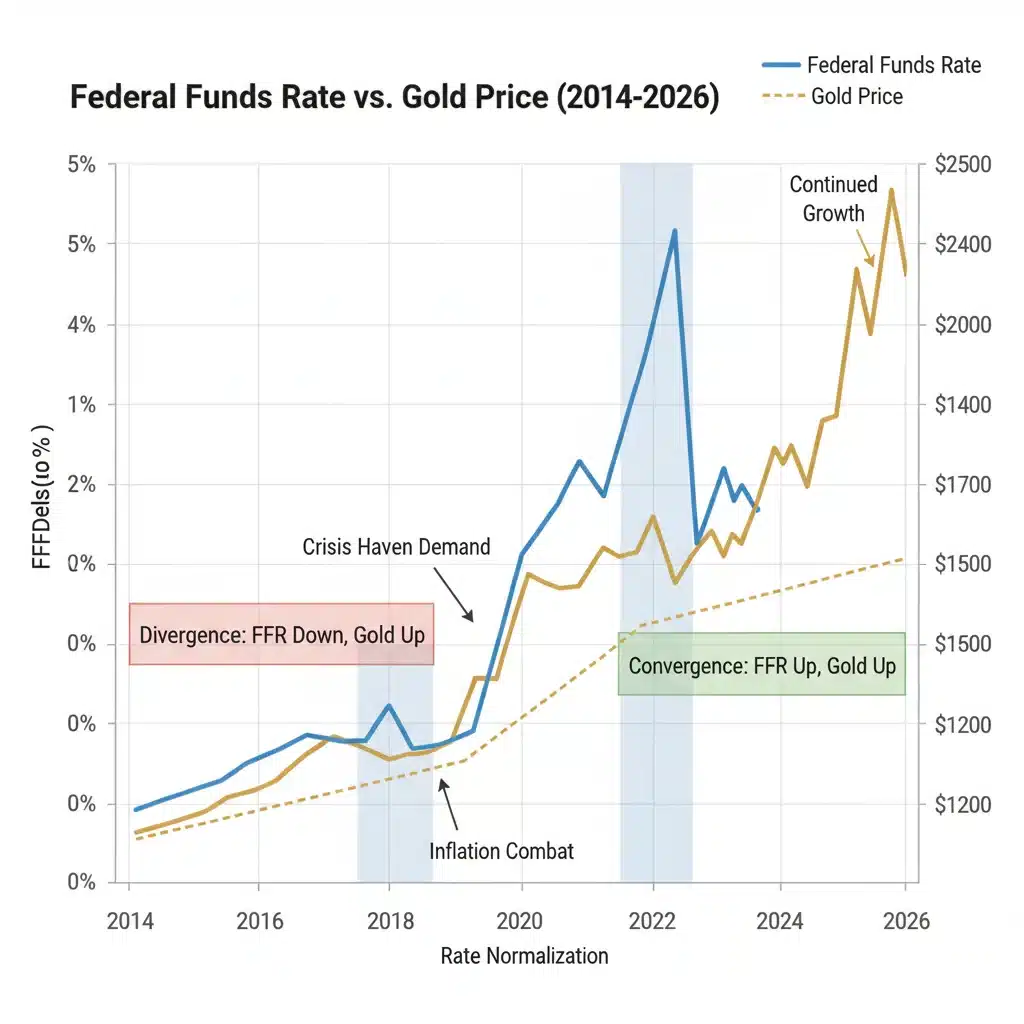
Assuming a scenario of continued economic normalization and inflation gradually returning towards the Fed’s target, it is reasonable to expect the federal funds rate to be at a more neutral level by 2026. A neutral rate is one that neither stimulates nor restricts economic growth. If the Fed has completed its tightening cycle by then, and perhaps even begins to consider minor rate cuts if economic growth falters, this could be supportive for gold. Lower interest rates reduce the opportunity cost of holding non-yielding gold, making it more attractive relative to bonds or other interest-bearing investments.
Conversely, if inflation proves more persistent than expected, or if the economy shows surprising resilience, the Fed might maintain higher interest rates for longer. Such a scenario would likely put downward pressure on gold prices, as the allure of higher yields on other assets would draw capital away from the precious metal. The market’s expectation of future rate hikes or cuts often has a more immediate impact on gold than the actual rate changes themselves.
Balance Sheet Normalization
By 2026, the Fed’s balance sheet normalization process (quantitative tightening) is likely to be well underway, or even nearing completion. The pace and magnitude of QT can influence long-term interest rates and overall market liquidity. A more aggressive QT could lead to tighter financial conditions, potentially weighing on economic growth and increasing the probability of a recession, which paradoxically could be good for gold as a safe haven. However, a smooth and gradual QT process might have a more muted impact, with investors focusing more on short-term rate decisions.
The size of the Fed’s balance sheet also has implications for the money supply. A shrinking balance sheet implies a reduction in the money supply, which, all else being equal, could be disinflationary. Lower inflation expectations generally reduce gold’s appeal as an inflation hedge. However, the interplay with other factors, such as government spending and global capital flows, makes this a complex dynamic for Fed policies gold.
Forward Guidance and Communication
The Fed’s forward guidance – its communication about the future path of monetary policy – is a powerful tool. Clear and consistent communication helps manage market expectations and reduces volatility. By 2026, the Fed will likely continue to provide guidance on its outlook for inflation, employment, and the appropriate path for interest rates. Any shifts in this guidance, particularly if they signal a more hawkish or dovish stance than anticipated, could trigger significant reactions in the gold market. Investors scrutinize every word from Fed officials for clues about future Fed policies gold implications.
External Factors Influencing Gold Beyond the Fed
While Federal Reserve policies are undeniably a major force, several other external factors will also shape gold prices in 2026. These interconnected elements create a dynamic environment where gold’s value is determined by a confluence of influences.
US Dollar Strength
Gold is typically priced in US dollars, meaning a stronger dollar generally makes gold more expensive for holders of other currencies, potentially dampening demand. Conversely, a weaker dollar can make gold more attractive. The strength of the dollar is influenced by interest rate differentials between the US and other major economies, the US economic outlook, and its status as a global reserve currency. If Fed policies gold lead to higher interest rates relative to other central banks, the dollar could strengthen, posing a headwind for gold.
Real Interest Rates
Perhaps one of the most critical determinants of gold prices is real interest rates – the nominal interest rate minus inflation. When real interest rates are low or negative, holding non-yielding gold becomes more attractive compared to bonds, which offer a negative real return. If Fed policies gold successfully bring down inflation while nominal rates remain relatively stable, real rates could rise, which would typically be bearish for gold. Conversely, if inflation unexpectedly surges and nominal rates lag, real rates could fall, boosting gold’s appeal.
Investment Demand and Speculative Positioning
The demand for gold from investors, including institutional funds, ETFs, and individual buyers, plays a significant role. Investor sentiment, often driven by fear or greed, can lead to substantial inflows or outflows from gold-backed assets. Speculative positioning in the futures market also influences short-term price movements. Major economic reports, Fed announcements, and geopolitical events can trigger shifts in investor sentiment, impacting Fed policies gold indirectly through demand channels.
Central Bank Gold Purchases
Beyond the Federal Reserve, other central banks globally are significant players in the gold market. Many central banks view gold as a strategic reserve asset, and their purchasing or selling activities can have a material impact on prices. Historically, central banks have been net buyers of gold, especially those seeking to diversify their reserves away from the US dollar. Continued strong central bank demand could provide a floor for gold prices, even in the face of potentially restrictive Fed policies gold.

Scenarios for Gold Prices in 2026 Under Different Fed Policy Paths
To provide a more concrete outlook for Fed policies gold in 2026, let’s consider a few plausible scenarios based on different Fed policy paths and economic outcomes.
Scenario 1: Gradual Normalization and Moderate Inflation
In this scenario, the Fed successfully navigates its dual mandate, with inflation gradually returning to its 2% target by 2026, and unemployment remaining low. The federal funds rate settles at a neutral level, and quantitative tightening proceeds smoothly. In this environment, gold might experience moderate price appreciation. With inflation under control and real interest rates stable but not excessively high, gold could maintain its role as a portfolio diversifier and a modest hedge against residual economic uncertainties. The absence of extreme fear or excessive liquidity might temper explosive gains, but a steady upward trend is possible.
Scenario 2: Persistent High Inflation and Hawkish Fed
If inflation proves more entrenched than anticipated, perhaps due to ongoing supply shocks or strong wage-price spirals, the Fed might be forced to maintain a more hawkish stance into 2026. This would entail higher interest rates for longer, and potentially a more aggressive balance sheet reduction. In this scenario, gold could face significant headwinds. Higher real interest rates would increase the opportunity cost of holding gold, pushing investors towards yielding assets. While gold often hedges against inflation, a Fed aggressively fighting inflation can create an environment where the dollar strengthens and yields rise, diminishing gold’s appeal.
Scenario 3: Economic Downturn and Dovish Pivot
Conversely, if the global economy experiences a significant slowdown or recession by 2026, the Fed might be compelled to pivot to a more dovish stance. This could involve cutting interest rates, halting quantitative tightening, or even considering new forms of quantitative easing. In such a risk-off environment, gold would likely shine brightly as a premier safe-haven asset. Lower interest rates and increased liquidity would reduce the opportunity cost of holding gold, while heightened economic uncertainty would drive investors to its perceived safety. This scenario would be highly bullish for Fed policies gold.
Investment Strategies for Gold in 2026
Given the potential impact of Fed policies gold, investors should consider adaptable strategies for 2026. Diversification remains key, but a nuanced understanding of gold’s role within a portfolio is crucial.
Long-Term Holding for Portfolio Diversification
For many investors, gold serves as a long-term hedge against systemic risks, currency debasement, and geopolitical instability. Regardless of short-term Fed actions, maintaining a strategic allocation to gold can provide portfolio diversification and act as a store of value across various economic cycles. This approach focuses on gold’s intrinsic value rather than its speculative price movements.
Tactical Allocation Based on Fed Signals
More active investors might employ a tactical allocation strategy, adjusting their gold exposure based on the Fed’s forward guidance, economic data releases, and real interest rate trends. For instance, if the Fed signals an imminent rate hike cycle, reducing gold exposure might be prudent. Conversely, if economic indicators point to a potential recession and a dovish Fed pivot, increasing gold holdings could be beneficial. This requires close monitoring of Fed policies gold implications.
Considering Gold-Related Assets
Beyond physical gold, investors can gain exposure through gold ETFs, gold mining stocks, or gold futures contracts. Each of these avenues carries different risk profiles and liquidity characteristics. Gold mining stocks, for example, can offer leverage to gold price movements but also come with operational risks. Understanding these nuances is important when constructing a gold investment strategy in anticipation of Fed policies gold impacts.
Conclusion
The interplay between Federal Reserve policies and gold prices in 2026 will be a critical determinant for investors. The Fed’s decisions on interest rates, balance sheet management, and inflation targeting will directly influence gold’s attractiveness relative to other assets. While a gradual normalization path might lead to moderate gains for gold, scenarios involving persistent high inflation or an economic downturn could lead to more pronounced movements, either negative or positive.
Investors must remain vigilant, closely monitoring economic data, Fed communications, and global developments. Gold’s role as a safe-haven asset and an inflation hedge will continue to be tested and reaffirmed in different economic environments. By understanding the potential implications of Fed policies gold, investors can better position their portfolios to navigate the uncertainties and opportunities that lie ahead in 2026 and beyond.