2026 Global Energy Transition: A Comparison of U.S. Policy vs. European Approaches
The year 2026 stands as a pivotal point in the ongoing global energy transition, a monumental shift from fossil fuels to sustainable, renewable sources. As the world grapples with the escalating climate crisis and the imperative for energy security, the approaches taken by major economic and political blocs, particularly the United States and Europe, offer fascinating insights into the complexities and diverse strategies involved. This comprehensive analysis will delve into the nuanced policy landscapes, investment trends, and technological advancements driving the global energy transition in both regions, highlighting their similarities, differences, and the potential implications for the rest of the world.
Anúncios
The urgency of the global energy transition cannot be overstated. Scientific consensus unequivocally points to the need for drastic reductions in greenhouse gas emissions to mitigate the most severe impacts of climate change. This necessitates a fundamental restructuring of energy systems, moving away from carbon-intensive energy generation towards cleaner alternatives. Beyond environmental concerns, the pursuit of energy independence, geopolitical stability, and economic opportunities also fuels this transformative journey. Both the US and Europe, albeit with distinct historical contexts and political structures, are at the forefront of this global endeavor, setting precedents and influencing the trajectory of the worldwide energy landscape.
The United States’ Approach to the Global Energy Transition
The United States, a nation historically reliant on fossil fuels, has seen a dynamic and often fluctuating commitment to the global energy transition. In 2026, the policy framework is shaped by a mix of federal initiatives, state-level mandates, and private sector innovation. The Biden administration’s ambitious climate goals and the Inflation Reduction Act (IRA) have significantly accelerated the pace of change, offering substantial tax credits and incentives for renewable energy deployment, electric vehicles, and clean manufacturing. This has created a robust environment for investment in solar, wind, and battery storage technologies.
Anúncios
However, the US approach is also characterized by its diverse political landscape. While some states, particularly on the coasts, are aggressively pursuing 100% renewable energy targets, others in the heartland maintain a strong focus on traditional energy industries. This creates a patchwork of regulations and incentives that can sometimes complicate a unified national strategy for the global energy transition. Despite these variations, the overall trend is towards decarbonization, driven by both federal policy and increasing consumer demand for sustainable options.
Key US Policies and Initiatives in 2026
- Inflation Reduction Act (IRA): This landmark legislation continues to be the cornerstone of US climate policy, providing billions in tax credits for clean energy technologies, electric vehicles, and energy efficiency upgrades. Its long-term certainty is a major driver for private investment in the global energy transition.
- Department of Energy (DOE) Programs: The DOE funds extensive research and development in areas like advanced nuclear, hydrogen, and carbon capture technologies, aiming to diversify the clean energy portfolio and address hard-to-decarbonize sectors.
- State Renewable Portfolio Standards (RPS): Many states have implemented or strengthened RPS, mandating a certain percentage of electricity to come from renewable sources by specific deadlines, thereby creating a guaranteed market for clean energy.
- Infrastructure Investment and Jobs Act: This act allocates significant funding for upgrading the electric grid, expanding charging infrastructure for EVs, and investing in public transit, all crucial components of the global energy transition.
Challenges and Opportunities for the US
One of the primary challenges for the US is grid modernization. The existing electricity grid was not designed for the influx of distributed renewable energy sources, requiring substantial investment in infrastructure upgrades, smart grid technologies, and energy storage solutions. Permitting processes for new transmission lines and renewable energy projects can also be lengthy, hindering rapid deployment. Furthermore, ensuring a just transition for communities reliant on fossil fuel industries remains a complex socio-economic issue.
On the opportunity front, the US boasts a strong innovation ecosystem, with leading universities and private companies driving technological breakthroughs. The abundance of natural resources, including land for solar and wind farms, and geological formations for carbon storage, provides a solid foundation for scaling up clean energy. The IRA’s incentives have also spurred a significant resurgence in domestic manufacturing of clean energy components, bolstering energy security and creating jobs within the global energy transition sector.
Europe’s Comprehensive Strategy for the Global Energy Transition
Europe, driven by the European Union (EU), has historically been a global leader in climate action and the global energy transition. Its approach is characterized by a comprehensive, bloc-wide strategy, often setting ambitious targets and implementing robust regulatory frameworks. The EU’s Green Deal, a set of policy initiatives aiming to make Europe climate-neutral by 2050, provides the overarching framework for its energy transformation.
European countries operate under a shared vision, though national implementations can vary. The emphasis is on collective action, cross-border cooperation, and a strong regulatory push to internalize the costs of carbon emissions. The EU’s Emissions Trading System (ETS) is a prime example, putting a price on carbon and incentivizing industries to reduce their footprint. Energy security, particularly in light of recent geopolitical events, has further accelerated the push towards renewable energy independence, reinforcing the commitment to the global energy transition.
Key European Policies and Initiatives in 2026
- European Green Deal: This overarching strategy encompasses a wide range of legislative proposals, including the ‘Fit for 55’ package, which aims to reduce net greenhouse gas emissions by at least 55% by 2030 compared to 1990 levels.
- EU Emissions Trading System (ETS): The ETS is a cornerstone of EU climate policy, setting a cap on emissions for heavy energy-using installations and airlines, thereby creating a market for carbon allowances.
- REPowerEU Plan: Launched in response to geopolitical events, REPowerEU aims to rapidly reduce dependence on Russian fossil fuels and accelerate the global energy transition by boosting renewable energy capacity, diversifying energy supplies, and improving energy efficiency.
- EU Taxonomy for Sustainable Activities: This regulation provides a classification system for environmentally sustainable economic activities, guiding investors towards green investments and promoting transparency in the sustainable finance market.
Challenges and Opportunities for Europe
Europe faces challenges related to energy infrastructure, particularly the need for cross-border transmission lines to integrate diverse renewable energy sources across member states. The reliance on energy imports for a significant portion of its energy needs also presents a vulnerability, though this is actively being addressed through the REPowerEU plan. Public acceptance for certain large-scale renewable projects, like offshore wind farms, can also be a hurdle in some regions. Furthermore, the economic impact of transitioning away from traditional industries in certain member states requires careful management.
The opportunities are vast. Europe’s long-standing commitment to sustainability has fostered a strong clean technology sector, with leading companies in wind, solar, and hydrogen. The integrated market within the EU allows for economies of scale and collaborative research and development. Strong public support for climate action provides a stable political environment for ambitious policies. Europe is also a leader in developing innovative financing mechanisms for green projects, further accelerating its global energy transition.
Comparative Analysis: US vs. European Approaches in 2026
While both the US and Europe are committed to the global energy transition, their pathways exhibit distinct characteristics.
Policy Drivers and Regulatory Frameworks
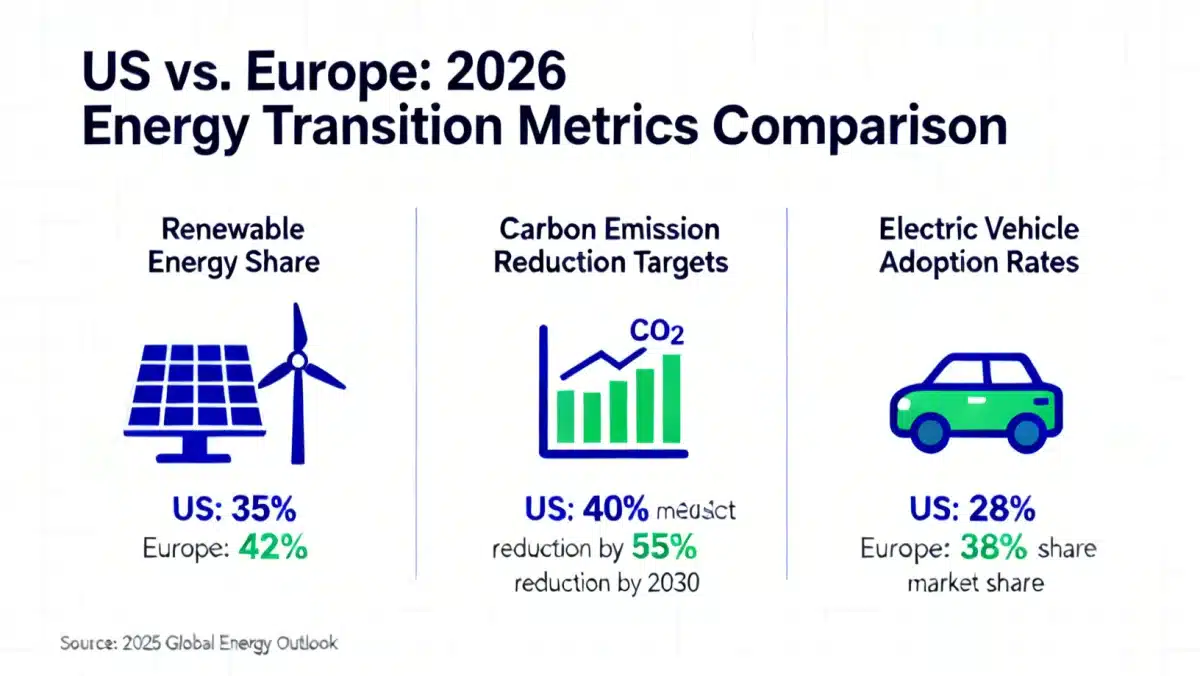
The US approach, particularly at the federal level, often relies heavily on financial incentives and tax credits to stimulate private sector investment. The IRA is a powerful example of this ‘carrots’ approach. While regulations exist, the emphasis is often on market-driven solutions. Europe, conversely, employs a more ‘sticks and carrots’ strategy, combining ambitious targets and regulatory mandates (like the ETS and ‘Fit for 55’ package) with significant financial support. This often leads to a more uniform and predictable regulatory environment across member states, even if implementation details vary.
Technological Focus and Investment
Both regions invest heavily in established renewable technologies like solar and wind. However, there are subtle differences in emphasis. The US has shown strong interest in carbon capture utilization and storage (CCUS) as a bridge technology, given its vast fossil reserves, and in advanced nuclear technologies. Europe, while also exploring these, places a strong emphasis on hydrogen as a key vector for decarbonizing heavy industry and transport, driven by its REPowerEU plan. Both regions are also heavily investing in battery storage and smart grid solutions.
Pace of Transition and Decarbonization Targets
Europe generally sets more aggressive and legally binding decarbonization targets, with the ‘Fit for 55’ package aiming for a 55% reduction in emissions by 2030. The US has also set ambitious goals, including a 50-52% reduction from 2005 levels by 2030, but the pathway to achieving these can be more susceptible to political shifts due to the decentralized nature of its policy-making. The EU’s integrated market and shared climate goals often allow for a more streamlined, albeit complex, implementation across its member states.
Energy Security and Geopolitical Considerations
For Europe, energy security has become an even more pressing driver for the global energy transition, especially following the geopolitical disruptions of recent years. Reducing reliance on imported fossil fuels from specific regions is a central tenet of its energy strategy. The US, with its abundant domestic fossil fuel resources, has a different energy security calculus, often balancing domestic production with the push for renewables. However, the broader economic and environmental benefits of clean energy also contribute to its energy independence goals.
The Role of Innovation and Research in the Global Energy Transition
Innovation is the bedrock of the global energy transition, and both the US and Europe are global leaders in this regard. Significant public and private funding is channeled into research and development across a spectrum of clean energy technologies.
Hydrogen Technologies
Hydrogen, particularly green hydrogen produced from renewable electricity, is a major focus for both regions. Europe has laid out an ambitious hydrogen strategy, aiming to scale up production and deploy it across various sectors, from industry to transport. The US, through initiatives like the Regional Clean Hydrogen Hubs, is also investing heavily in developing a domestic hydrogen economy. The potential of hydrogen to decarbonize hard-to-abate sectors like steel, cement, and heavy-duty transport makes it a critical component of the future energy mix.
Advanced Nuclear and Small Modular Reactors (SMRs)
Both the US and Europe recognize the potential of advanced nuclear power, particularly Small Modular Reactors (SMRs), to provide reliable, carbon-free baseload electricity. The US Department of Energy has been a strong proponent of SMR development, seeing it as a key technology for achieving decarbonization goals. Several European countries are also exploring SMRs as part of their long-term energy strategies, though public opinion on nuclear energy remains varied across the continent. SMRs offer advantages in terms of reduced construction time, lower capital costs, and greater flexibility compared to traditional large-scale nuclear plants.
Grid Modernization and Energy Storage
The integration of intermittent renewable energy sources like solar and wind necessitates a smarter, more resilient electricity grid and advanced energy storage solutions. Both the US and Europe are investing heavily in grid modernization, including smart meters, demand-side management, and advanced transmission infrastructure. Battery storage technologies, from utility-scale installations to residential systems, are rapidly advancing and becoming more cost-effective. Research into long-duration energy storage, such as pumped hydro, compressed air, and thermal storage, is also critical for ensuring grid stability and reliability as renewable penetration increases.
The Economic and Social Dimensions of the Global Energy Transition
The global energy transition is not merely a technological shift; it has profound economic and social implications that both the US and Europe are actively addressing.
Job Creation and Workforce Transition
The clean energy sector is a significant source of job creation, from manufacturing and installation to research and development. Both regions are focused on developing workforce training programs to equip workers with the skills needed for the new energy economy. This includes reskilling workers from traditional fossil fuel industries, ensuring a just transition that minimizes economic disruption in affected communities. The growth of jobs in solar, wind, electric vehicles, and energy efficiency sectors is a major economic benefit of the transition.
Investment and Green Finance
Trillions of dollars are required to finance the global energy transition. Both the US and Europe are developing innovative financial mechanisms to attract private capital. In the US, the tax credits from the IRA have unlocked significant private investment. In Europe, the EU Taxonomy and various green bond initiatives are guiding investment towards sustainable projects. The development of robust green finance markets is crucial for scaling up clean energy infrastructure and technologies.
Consumer Adoption and Behavior
Consumer adoption of electric vehicles, rooftop solar, and energy-efficient appliances is vital for the success of the global energy transition. Both regions are implementing policies to incentivize these behaviors, such as purchase rebates for EVs, feed-in tariffs for solar, and energy efficiency standards for buildings. Public awareness campaigns and educational initiatives also play a crucial role in fostering a societal shift towards more sustainable lifestyles.
Global Implications and Future Outlook
The strategies pursued by the US and Europe in their respective global energy transition journeys have significant implications for the rest of the world. Their technological advancements, policy innovations, and investment patterns often serve as blueprints or benchmarks for other nations. Collaboration between these major economic blocs, particularly in areas like research and development, standardization, and climate diplomacy, is essential for accelerating the worldwide shift to clean energy.
Looking ahead to 2026 and beyond, the global energy transition will continue to be characterized by innovation, policy evolution, and increasing international cooperation. While challenges remain, including geopolitical complexities, supply chain vulnerabilities, and the need for massive infrastructure development, the momentum towards a sustainable energy future is undeniable. The lessons learned from the US and European experiences will be invaluable as the world collectively strives to meet climate goals and build a resilient, clean energy economy.
Conclusion
The 2026 global energy transition is a complex, multi-faceted undertaking, with the United States and Europe showcasing distinct yet complementary approaches. The US, with its market-driven incentives and focus on innovation, and Europe, with its comprehensive regulatory framework and ambitious targets, both contribute significantly to the global decarbonization effort. While their methodologies may differ, their shared ultimate goal of a sustainable, climate-neutral future underscores the universal imperative of moving beyond fossil fuels.
As the world progresses further into the 21st century, the collaborative efforts, technological breakthroughs, and policy lessons from these two economic powerhouses will be crucial in shaping a truly global energy transition. The journey is long and arduous, but the commitment to a cleaner, more secure energy future remains unwavering, driven by both environmental necessity and economic opportunity.