Maximize 2026 Social Security: 3 Lesser-Known Strategies for Up to $200 More Monthly

Anúncios
Insider Report: Maximize Your 2026 Social Security Benefits with These 3 Lesser-Known Strategies, Boosting Payouts by Up to $200 Monthly
For millions of Americans, Social Security represents a cornerstone of their retirement income. As we look ahead to 2026, understanding how to maximize social security benefits becomes more crucial than ever. While many are aware of the basic rules, a significant number of retirees and pre-retirees are leaving money on the table, often due to a lack of awareness regarding specific, lesser-known strategies. This comprehensive guide will delve into three powerful tactics that could potentially boost your monthly Social Security payout by up to $200, making a tangible difference in your financial security during your golden years. Our goal is to equip you with the knowledge to navigate the complexities of Social Security and ensure you receive every dollar you’re entitled to.
Anúncios
Understanding the Foundation: How Social Security Benefits Are Calculated
Before we dive into the advanced strategies to maximize social security, it’s essential to grasp the fundamentals of how your benefits are determined. Your Social Security retirement benefit is based on your average indexed monthly earnings (AIME) during your 35 highest-earning years. The Social Security Administration (SSA) then applies a progressive formula to your AIME to arrive at your primary insurance amount (PIA). This PIA is the amount you’re entitled to receive at your Full Retirement Age (FRA).
Key Factors Influencing Your PIA:
- Earnings Record: The higher your earnings over your career, up to the annual taxable maximum, the higher your potential benefit.
- Years Worked: The SSA uses your 35 highest-earning years. If you have fewer than 35 years of earnings, zero-earning years will be averaged in, reducing your overall benefit.
- Full Retirement Age (FRA): This is the age at which you’re eligible to receive 100% of your PIA. FRA varies based on your birth year. For those born in 1960 or later, FRA is 67.
Understanding these foundational elements is the first step in strategically planning how to maximize social security. Many people simply claim benefits at the earliest possible age (62) without fully understanding the long-term financial implications. This often results in a permanently reduced monthly payment. Our strategies will focus on leveraging these foundational rules, and some less obvious ones, to your advantage.
Strategy 1: The Power of Delayed Claiming Beyond Full Retirement Age
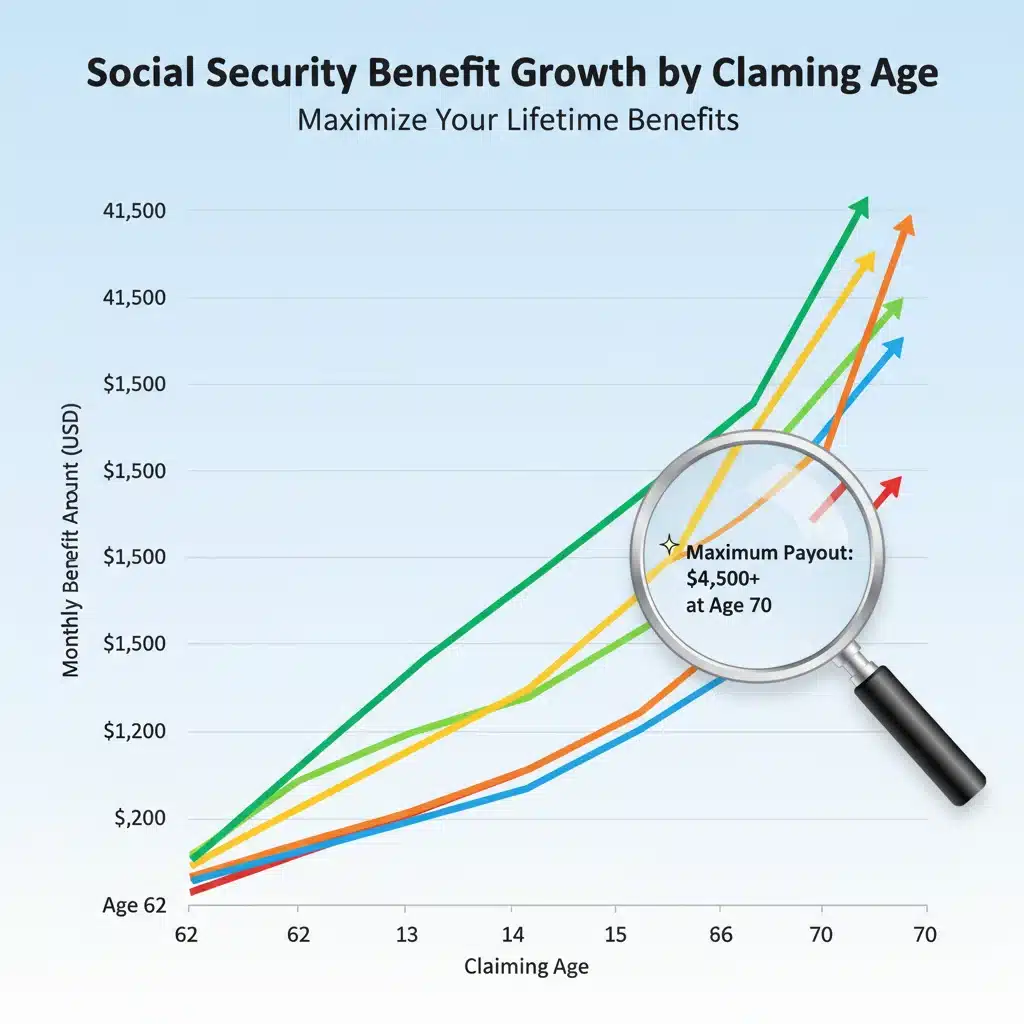
One of the most impactful, yet often underutilized, strategies to maximize social security is delaying your claim beyond your Full Retirement Age (FRA). While many are eager to start receiving benefits as soon as possible, waiting can lead to a significantly higher monthly payout for the rest of your life. For every year you delay claiming benefits past your FRA, up to age 70, your monthly benefit increases by a certain percentage, known as Delayed Retirement Credits (DRCs).
Anúncios
How Delayed Retirement Credits (DRCs) Work:
DRCs are a powerful incentive to wait. For individuals born in 1943 or later, your benefit increases by 8% for each year you delay claiming past your FRA, up to age 70. This means that if your FRA is 67, and you wait until age 70 to claim, your monthly benefit will be 124% of your PIA. That’s a 24% increase compared to claiming at FRA, and an even more substantial increase compared to claiming at age 62.
Example Scenario:
- PIA at FRA (Age 67): $1,800 per month
- Claiming at Age 62: Benefit reduced by approximately 30%, resulting in $1,260 per month.
- Claiming at Age 70: Benefit increased by 24%, resulting in $2,232 per month.
In this example, delaying from age 62 to age 70 could mean an extra $972 per month, or an extra $432 per month compared to claiming at FRA. Over a lifetime, this difference can amount to hundreds of thousands of dollars. The decision to delay is highly personal and depends on several factors, including your health, other retirement income sources, and immediate financial needs. However, for those who can afford to wait, it’s arguably the most straightforward way to maximize social security benefits.
Considerations for Delayed Claiming:
- Health and Longevity: If you anticipate a long lifespan, the cumulative increase in benefits from delayed claiming can be substantial.
- Other Income Sources: If you have sufficient retirement savings, pensions, or continued employment, you might be able to bridge the gap until age 70.
- Spousal Benefits: Delaying your own benefits can also positively impact potential spousal or survivor benefits for your spouse.
It’s crucial to analyze your personal situation carefully when considering delayed claiming. The potential for a significantly higher monthly income, potentially boosting your payout by up to $200 or more, makes this strategy an absolute must-consider for anyone looking to maximize social security.
Strategy 2: Strategic Use of Spousal and Survivor Benefits
Beyond your own work record, Social Security offers valuable spousal and survivor benefits that can be strategically utilized to maximize social security for a couple or an individual. These benefits are often overlooked or misunderstood, leading many to miss out on significant additional income.
Spousal Benefits Explained:
If you are married, divorced, or widowed, you may be eligible for benefits based on your spouse’s or ex-spouse’s earnings record. A spouse can receive up to 50% of their partner’s PIA at their own FRA, provided their partner has already filed for their own benefits. If your own PIA is less than 50% of your spouse’s, claiming spousal benefits can be a powerful way to increase your household’s overall Social Security income.
“File and Suspend” (Pre-2016 Rules) vs. Current Rules:
Prior to 2016, a strategy known as “File and Suspend” allowed one spouse to file for their benefits (triggering spousal benefits for the other) and then immediately suspend their own, allowing their benefits to continue growing with DRCs until age 70. This option is no longer available. However, current rules still allow for strategic claiming.
Restricted Application for Spousal Benefits (for those born before January 2, 1954):
If you were born before January 2, 1954, you may still be able to file a “restricted application” for spousal benefits only at your FRA, allowing your own benefits to continue accruing DRCs until age 70. This means you can collect spousal benefits for a few years while your own benefit grows, then switch to your higher individual benefit at age 70. This is a crucial distinction and a powerful tool to maximize social security for eligible individuals.
Survivor Benefits:
If your spouse passes away, you may be eligible for survivor benefits. A widow or widower can receive 100% of their deceased spouse’s benefit at their own FRA, or a reduced amount as early as age 60 (or age 50 if disabled). This is particularly important because if the deceased spouse had delayed claiming and accumulated DRCs, the survivor benefit will be higher. This provides a critical safety net and another avenue to maximize social security for the surviving partner.

Key Considerations for Couples:
- Coordination is Key: Couples should work together to determine the optimal claiming strategy. Often, the higher earner delays claiming until age 70 to maximize the primary benefit and the potential survivor benefit, while the lower earner might claim earlier or utilize spousal benefits.
- Divorced Spouses: If you were married for at least 10 years and are currently unmarried, you may be eligible for benefits based on your ex-spouse’s record, even if they have remarried. Your ex-spouse does not need to know you are claiming, and it does not affect their benefits or their current spouse’s benefits.
- Understanding the “Higher of the Two” Rule: You generally receive either your own benefit or your spousal/survivor benefit, whichever is higher. You don’t get both simultaneously, but strategic claiming can allow you to switch from one to the other at an optimal time.
Navigating spousal and survivor benefits requires careful planning and an understanding of the specific rules based on your birth year and marital status. However, for many couples and individuals, these benefits represent a significant opportunity to maximize social security payouts, potentially adding hundreds of dollars to monthly household income.
Strategy 3: Optimizing Your Earnings Record and Work History
While the first two strategies focus on claiming age and spousal benefits, this third strategy goes back to the source: your work history and earnings record. Many people overlook the direct impact their career earnings have on their future Social Security benefits. Optimizing your earnings record, even in the years leading up to retirement, can be a surprisingly effective way to maximize social security.
The 35-Year Rule: Maximize Your High-Earning Years
As mentioned, the SSA calculates your benefit based on your 35 highest-earning years. If you work fewer than 35 years, zero-earning years will be averaged into your calculation, significantly reducing your AIME and, consequently, your PIA. Conversely, if you have more than 35 years of earnings, the lowest-earning years will be dropped, replaced by higher-earning ones.
Impact of Working Longer:
If you’re nearing retirement and have fewer than 35 years of substantial earnings, or if your current earnings are higher than some of your early career earnings, working a few extra years can have a profound impact. Each additional year you work, especially if it replaces a low-earning or zero-earning year, will increase your AIME and thus your PIA. This can be a straightforward way to maximize social security without complex claiming strategies.
Example: Replacing Low-Earning Years
Imagine a scenario where you worked for 30 years, took a five-year break, and are now considering retirement. Those five years without earnings will be counted as zeros in your 35-year average, drastically lowering your benefit. If you work for another five years at a decent salary, those new, higher-earning years will replace the five zero-earning years, substantially increasing your average and your monthly benefit.
Reviewing Your Social Security Earnings Statement:
It is absolutely critical to regularly review your Social Security earnings statement. You can do this by creating an account on the official SSA website (www.ssa.gov). Your earnings statement provides a year-by-year breakdown of your reported earnings. Errors, though rare, can occur. If your earnings are incorrectly reported, it could negatively impact your future benefits. Promptly reporting and correcting any discrepancies is vital to ensure your benefit calculation is accurate.
What to Look For:
- Missing Earnings: Ensure all your employers have accurately reported your income.
- Incorrect Amounts: Check that the reported amounts match your W-2s or tax returns.
- Years with Low or No Earnings: Identify periods where working longer could replace these years with higher earnings.
Maximizing Earnings Up to the Taxable Maximum:
Each year, there’s a Social Security taxable maximum – an income threshold above which earnings are not subject to Social Security taxes and do not count towards your benefit calculation. While most people don’t earn above this limit, if you are a high earner and have some flexibility in your compensation (e.g., bonuses, deferred compensation), understanding this limit can be part of a broader strategy to maximize social security. Ensuring your highest earning years are captured up to this maximum is key.
By actively managing and optimizing your earnings record, you’re not just passively waiting for retirement; you’re actively building the foundation for a higher Social Security benefit. This proactive approach, combined with strategic claiming, forms a robust plan to maximize social security and secure your financial future.
Integrating Strategies for Maximum Impact in 2026
The true power of these strategies lies in their integration. While each strategy – delayed claiming, strategic use of spousal/survivor benefits, and optimizing your earnings record – can individually boost your benefits, combining them where applicable can lead to the most significant increase in your monthly Social Security payout. For 2026, understanding these nuances will be more important than ever as economic factors and cost-of-living adjustments (COLAs) continue to shape benefit amounts.
A Holistic Approach to Retirement Planning:
- Start Early: The earlier you begin planning, the more options you’ll have to maximize social security. Understanding your Full Retirement Age, reviewing your earnings, and discussing claiming strategies with your spouse should not be last-minute tasks.
- Consult a Financial Advisor: Social Security rules can be complex, especially when dealing with unique situations like divorce, disability, or government pensions. A qualified financial advisor specializing in retirement planning can help you analyze your specific situation and develop a personalized strategy. They can run scenarios that illustrate the long-term impact of different claiming ages and benefit types.
- Utilize SSA Tools: The Social Security Administration’s website offers a wealth of information and tools, including benefit calculators that can help you estimate your future payments under different claiming scenarios. Use these resources to project your benefits and understand the financial implications of your decisions.
- Stay Informed: Social Security rules and benefit calculations can change. Keep abreast of any legislative updates or policy changes that might affect your benefits. Reliable financial news sources and the SSA website are excellent resources.
For example, a couple where one spouse is a high earner and the other a lower earner might implement a strategy where the higher earner works until age 70 to maximize social security their individual benefit and the potential survivor benefit. Simultaneously, the lower-earning spouse might file a restricted application for spousal benefits at their FRA (if eligible) while their own benefit continues to grow, switching to their higher individual benefit at age 70. This coordinated approach can significantly enhance the household’s total lifetime benefits.
The $200 Monthly Boost: A Realistic Goal
Achieving a $200 monthly boost in your Social Security benefits is a very realistic goal when employing these strategies. Consider the combination of:
- Delayed Claiming: Waiting just one or two years past FRA can easily add $100-$200 or more to your monthly check, depending on your PIA.
- Optimizing Earnings: Replacing a few low-earning years with higher ones can incrementally increase your AIME, leading to a higher base benefit.
- Spousal/Survivor Benefits: For many couples, correctly timing spousal benefits can add a substantial amount to the household income, or ensure a much higher survivor benefit for the remaining spouse.
Individually, these strategies are powerful. Together, they form a formidable plan to ensure you maximize social security benefits and enjoy a more financially secure retirement. The key is proactive planning and a deep understanding of the options available to you.
Common Pitfalls to Avoid When Claiming Social Security
While focusing on strategies to maximize social security is important, it’s equally crucial to be aware of common mistakes that can lead to reduced benefits. Avoiding these pitfalls can save you significant money over your retirement years.
1. Claiming Too Early Without Understanding the Consequences:
The most common mistake is claiming benefits at age 62 simply because it’s the earliest option. While it provides immediate income, it results in a permanent reduction of up to 30% of your PIA. For many, this reduction far outweighs the benefit of receiving payments for a few extra years, especially if they live a long life. Always compare the reduced benefits at 62 with your FRA and age 70 benefits.
2. Not Reviewing Your Earnings Record Annually:
As discussed, errors in your earnings record can directly impact your benefits. Failing to check your Social Security statement for accuracy can lead to a lower benefit than you’re entitled to. Make it a habit to review your statement annually on the SSA website.
3. Misunderstanding Spousal and Survivor Benefits:
Many couples fail to coordinate their claiming strategies, leading to suboptimal outcomes. Forgetting about eligibility for divorced spousal benefits or not understanding how survivor benefits work can leave money on the table. Always explore all available benefit types for which you and your family might qualify.
4. Working While Receiving Benefits Below FRA:
If you claim Social Security benefits before your Full Retirement Age (FRA) and continue to work, your benefits may be reduced if your earnings exceed a certain limit. In 2024, for example, if you are under FRA for the entire year, the SSA deducts $1 from your benefits for every $2 you earn above $22,320. In the year you reach FRA, the deduction is $1 for every $3 earned above a higher limit ($59,520 in 2024) until the month you reach FRA. Once you reach FRA, your benefits are no longer subject to these earnings limits. Understanding these limits is crucial to maximize social security without unexpected reductions.
5. Not Considering Tax Implications:
A portion of your Social Security benefits may be taxable if your combined income (adjusted gross income + nontaxable interest + half of your Social Security benefits) exceeds certain thresholds. While this doesn’t directly reduce your Social Security payout, it affects your net income. Factor potential taxes into your overall retirement income planning.
6. Failing to Plan for Longevity:
People are living longer, healthier lives. A strategy that maximizes your monthly benefit, particularly through delayed claiming, can provide a more substantial income stream throughout a potentially longer retirement. Underestimating your lifespan can lead to claiming too early and running out of sufficient funds later in life.
By actively avoiding these common pitfalls, alongside implementing the three core strategies, you significantly enhance your ability to maximize social security and ensure a more comfortable and secure retirement.
Conclusion: Take Control of Your 2026 Social Security Benefits
The journey to a financially secure retirement is multifaceted, and Social Security plays a pivotal role for most Americans. As we look towards 2026, the opportunity to maximize social security benefits by up to $200 monthly is not just a dream, but a tangible reality for those willing to engage in thoughtful planning. By understanding and strategically applying the three lesser-known strategies discussed – the power of delayed claiming, the intelligent use of spousal and survivor benefits, and the optimization of your earnings record – you can significantly impact your financial well-being.
Remember, your Social Security benefit is not a fixed sum; it’s a dynamic figure influenced by the choices you make throughout your career and particularly in the years leading up to and during retirement. Don’t leave money on the table. Take the time to:
- Educate Yourself: Understand the rules, your Full Retirement Age, and how your earnings history impacts your benefits.
- Plan Strategically: Consider all claiming scenarios, especially for couples, and weigh the pros and cons of early vs. delayed claiming.
- Review and Verify: Regularly check your Social Security earnings statement for accuracy.
- Seek Expert Advice: A qualified financial advisor can provide personalized guidance tailored to your unique circumstances.
By taking a proactive and informed approach, you empower yourself to make the best decisions for your financial future. The potential for an extra $200 (or more) per month can translate into thousands of additional dollars over your retirement, offering greater peace of mind and the ability to enjoy your golden years to the fullest. Start planning today to maximize social security and secure the retirement you deserve.