
Unlock Massive Community College Savings: How 2026 Programs Can Cut Your Degree Costs by 40%
Anúncios
In an era where the cost of higher education continues to climb, making a college degree seem out of reach for many, community colleges are emerging as beacons of affordability and accessibility. As we look towards 2026, new programs and evolving educational landscapes are set to supercharge the financial benefits of attending a community college, potentially saving students up to 40% on their overall degree costs. This isn’t just about saving money; it’s about smart educational planning, maximizing value, and securing a brighter future without the burden of crippling debt. Understanding these opportunities for Community College Savings is crucial for prospective students and their families.
The traditional path of going straight to a four-year university after high school is no longer the only, or even the most financially prudent, option. Community College Savings offer a strategic alternative, allowing students to complete their general education requirements, explore career paths, and even earn associate degrees at a fraction of the cost. The credits earned are often fully transferable to four-year institutions, providing a seamless transition to a bachelor’s degree. This article will delve deep into how these savings are achieved, what specific programs to look out for in 2026, and how this approach can significantly boost your enrollment and academic success.
The Soaring Cost of Higher Education: Why Community College Savings are More Critical Than Ever
The sticker price of a four-year university education has become a formidable barrier for countless students. Tuition fees, room and board, books, and living expenses can easily add up to tens of thousands of dollars per year, leading to an average student loan debt that often exceeds $30,000 upon graduation. This financial strain can delay major life milestones, from buying a home to starting a family, and can impact career choices as graduates prioritize high-paying jobs to service their debt.
Anúncios
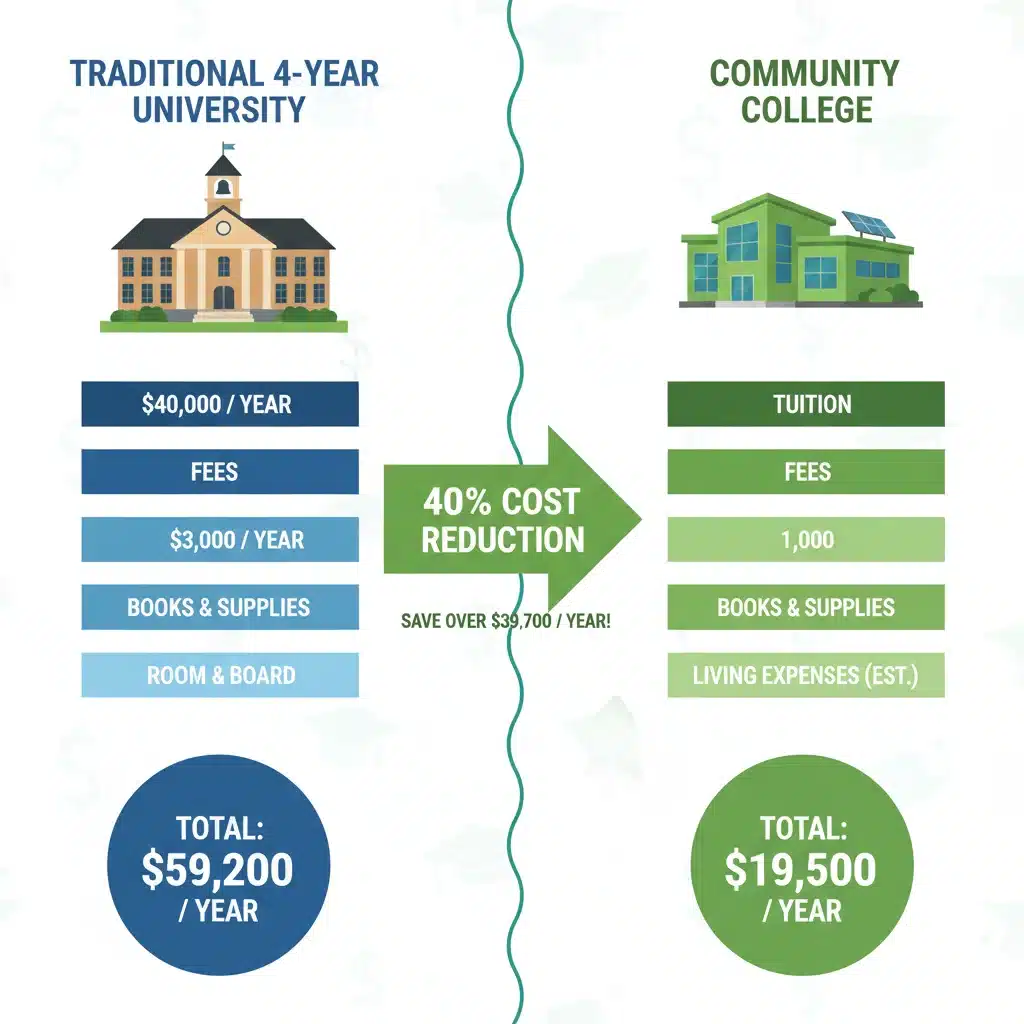
This escalating cost makes the value proposition of Community College Savings incredibly compelling. Community colleges typically have significantly lower tuition rates compared to public and private universities. For example, the average annual tuition and fees at a public two-year institution can be less than one-third of that at a public four-year university. When you factor in the ability to live at home, commute, and potentially work part-time, the financial relief becomes even more pronounced. This initial cost reduction is the cornerstone of the 40% savings we’re discussing.
Furthermore, the economic uncertainties of recent years have highlighted the need for flexible, affordable, and career-focused education. Community colleges are uniquely positioned to meet these demands, offering pathways that are both academically rigorous and directly linked to workforce needs. As we approach 2026, these institutions are set to enhance their offerings, making the decision to start there an even smarter financial and academic move. The focus on Community College Savings isn’t just a trend; it’s a strategic response to a national challenge.
Breaking Down the 40% Savings: Where Your Money Goes Further
Achieving a 40% reduction in your degree costs through community college isn’t a pipe dream; it’s a calculated strategy based on several key factors:
1. Significantly Lower Tuition and Fees
The most obvious and substantial source of Community College Savings comes from tuition. As mentioned, community college tuition can be dramatically lower than university rates. By completing the first two years of a bachelor’s degree at a community college, you’re essentially getting the foundational courses at a discounted rate. This alone can account for a significant portion of the overall savings. Many states also offer in-state tuition benefits for community college students, further reducing the financial burden.
2. Reduced Living Expenses
For many university students, the cost of room and board is a major expense. By attending a local community college, students often have the option to live at home, eliminating these costs entirely or drastically reducing them. Even if you choose to live independently, local housing near a community college is typically more affordable than university-affiliated housing or apartments near major university campuses. This flexibility in living arrangements contributes significantly to overall Community College Savings.
3. Flexible Scheduling and Part-Time Work Opportunities
Community colleges often offer more flexible class schedules, including evening, weekend, and online options. This flexibility allows many students to work part-time or even full-time while pursuing their education, earning money to offset educational and living expenses. This ability to earn while learning is a powerful component of maximizing Community College Savings and minimizing the need for student loans.
4. Targeted Program Costs
Many community colleges offer vocational and technical programs that are designed to lead directly to employment or provide specialized skills quickly. These programs often have lower overall costs and shorter completion times than traditional four-year degrees, yet they lead to well-paying jobs. For students focused on specific career paths, these targeted programs can offer immense value and considerable Community College Savings.
5. Financial Aid and Scholarships
Despite their already lower costs, community college students are still eligible for various forms of financial aid, including federal Pell Grants, state grants, and institutional scholarships. Because the overall cost is lower, the available financial aid often covers a larger percentage of the expenses, sometimes even making tuition free for eligible students. This amplifies the Community College Savings potential, making education accessible to a wider demographic.
2026 and Beyond: Emerging Programs and Initiatives Boosting Community College Savings
The landscape of community college education is not static; it’s continually evolving to meet the needs of students and the workforce. As we approach 2026, several trends and specific initiatives are set to further enhance the value and affordability of community colleges:
1. Enhanced Transfer Agreements and Pathways
Many states and individual institutions are working to streamline the transfer process from community colleges to four-year universities. By 2026, we can expect even more comprehensive articulation agreements, guaranteed admission programs, and clear academic pathways that ensure community college credits transfer seamlessly. This reduces the risk of lost credits and wasted time, directly contributing to Community College Savings by ensuring a more efficient path to a bachelor’s degree.
2. Workforce Development and Apprenticeship Programs
Community colleges are increasingly partnering with local industries to create highly relevant workforce development and apprenticeship programs. These programs often combine classroom instruction with on-the-job training, providing students with valuable experience and often a paid income during their studies. Graduates emerge with in-demand skills and direct pathways to employment, minimizing post-graduation job search time and maximizing their return on investment. These programs are designed for efficiency and direct career readiness, offering significant Community College Savings compared to a traditional university degree.
3. Dual Enrollment Expansion
Dual enrollment programs, which allow high school students to earn college credits, are expected to expand significantly by 2026. By starting college credits early, students can reduce the total time and cost of their higher education. These credits are typically offered at a reduced rate or even free for high school students, providing a head start on Community College Savings before they even graduate high school.
4. Online and Hybrid Learning Innovations
The acceleration of online learning capabilities means that by 2026, community colleges will offer an even wider array of high-quality online and hybrid courses and programs. This flexibility not only caters to diverse learning styles and schedules but can also reduce commuting costs and allow students to maintain employment more easily, further enhancing Community College Savings.
5. Open Educational Resources (OER) Adoption
Many community colleges are at the forefront of adopting Open Educational Resources (OER) – free, openly licensed educational materials – in place of expensive textbooks. This initiative can save students hundreds, if not thousands, of dollars over the course of their degree, directly contributing to the 40% Community College Savings goal. The trend towards OER is expected to strengthen by 2026, making education even more affordable.
The Enrollment Boost: Why More Students are Choosing Community Colleges
The financial benefits of Community College Savings are a major draw, but they are not the only reason for growing enrollment. Community colleges offer a unique educational environment that caters to a broad spectrum of learners:
1. Accessible Entry Requirements
Community colleges typically have open enrollment policies, making higher education accessible to students who might not meet the stringent admission criteria of four-year universities, or who are returning to education after a break. This inclusivity fosters a diverse student body and provides opportunities for everyone to pursue their academic and career goals.
2. Smaller Class Sizes and Personalized Attention
Compared to large universities, community colleges often boast smaller class sizes. This allows for more personalized attention from instructors, better opportunities for student-faculty interaction, and a more supportive learning environment. This can be particularly beneficial for students transitioning from high school or those who benefit from more individualized guidance, contributing to academic success and retention.
3. Career-Focused Education and Practical Skills
Beyond transfer programs, community colleges excel in providing career and technical education (CTE) that directly addresses local workforce needs. From nursing and allied health to automotive technology, culinary arts, and IT, these programs equip students with practical, in-demand skills that lead directly to employment. The focus on practical application and industry-relevant curriculum makes graduates highly marketable. This direct path to employment minimizes the time spent in education and maximizes earning potential, further enhancing the impact of Community College Savings.
4. Local Community Integration
Community colleges are deeply embedded in their local communities, serving as educational hubs, cultural centers, and engines for economic development. This local connection means that programs are often tailored to regional job markets, and students can build local networks that are invaluable for future career opportunities. The convenience of a local institution also contributes to the overall affordability by reducing relocation costs.
Strategies to Maximize Your 40% Community College Savings by 2026
To truly leverage the potential for 40% Community College Savings, prospective students should adopt a proactive and informed approach:
1. Plan Your Transfer Path Early
If your goal is a bachelor’s degree, work closely with a community college academic advisor from day one to map out your course selections for seamless transfer to your target four-year university. Understand articulation agreements and specific program requirements to avoid taking unnecessary courses. This foresight is key to maximizing Community College Savings.
2. Apply for All Available Financial Aid
Complete the Free Application for Federal Student Aid (FAFSA) every year, even if you think you won’t qualify. Explore state grants, institutional scholarships, and private scholarships specifically for community college students. Every dollar of aid reduces your out-of-pocket expenses and enhances your Community College Savings.
3. Take Advantage of Dual Enrollment
If you’re a high school student, inquire about dual enrollment opportunities. Earning college credits while still in high school is one of the most effective ways to reduce the overall cost and time to degree completion. This is a powerful head start on your Community College Savings.
4. Consider Vocational and Technical Programs
If a specific career path interests you, research the community college’s vocational and technical offerings. These programs often lead to excellent job prospects with shorter completion times and lower costs than traditional degrees, offering a different but equally valuable form of Community College Savings.
5. Utilize Campus Resources
Community colleges offer a wealth of support services, including tutoring, career counseling, library resources, and student success centers. Taking advantage of these free resources can help you succeed academically, stay on track, and avoid costly setbacks, indirectly contributing to your Community College Savings by ensuring efficient progress.

Real-World Impact: Stories of Community College Savings Success
The impact of community colleges on individual lives and the economy is profound. Consider Sarah, who wanted to become a nurse but faced the daunting tuition of a four-year university. She opted to complete her Associate Degree in Nursing at her local community college, saving over $25,000 in tuition and living expenses over two years. She then seamlessly transferred her credits to a state university to complete her Bachelor of Science in Nursing (BSN) while working part-time as a registered nurse, earning income to cover her remaining tuition. Her total degree cost was nearly 40% less than if she had started directly at the university, and she graduated with minimal debt.
Another example is David, who was unsure about his career path after high school. He enrolled in a community college’s general education program, exploring different subjects at a low cost. He discovered a passion for cybersecurity through an introductory course and transitioned into a specialized IT program. Within two years, he earned an associate degree and several industry certifications, landing a high-paying job in network security. His initial investment was minimal, and his rapid entry into the workforce translated into significant long-term financial gains, far surpassing the typical university student’s initial earnings. These stories underscore the tangible benefits of prioritizing Community College Savings.
The Future of Affordable Education is Now
The year 2026 is not far off, and the trends point towards an even stronger role for community colleges in making higher education affordable and accessible. The opportunity to achieve significant Community College Savings – potentially up to 40% on your degree – is a real and achievable goal. By understanding the financial advantages, exploring the diverse program offerings, and strategically planning your educational journey, you can unlock a path to a valuable degree without accumulating overwhelming debt.
Embracing community college as a first step or even a complete educational journey is a smart financial and academic decision. It’s a testament to the evolving educational landscape, where value, flexibility, and career readiness are paramount. Don’t let the fear of college costs deter you from your dreams. Explore the myriad opportunities for Community College Savings and pave your way to a successful and financially sound future.