SSDI/SSI 2026: Boost Your Disability Benefits Approval Odds by 25%

Anúncios
Securing Social Security Disability Insurance (SSDI) or Supplemental Security Income (SSI) benefits can be a lifeline for individuals unable to work due to a significant disability. However, navigating the application process is often complex, lengthy, and can feel overwhelming. With potential changes and evolving criteria, staying informed about disability benefits 2026 is paramount for a successful application. This comprehensive guide aims to shed light on recent updates, provide strategies to significantly improve your approval odds, and ensure you are well-prepared for what lies ahead.
The Social Security Administration (SSA) reviews millions of applications annually, and a significant percentage are initially denied. This isn’t necessarily due to a lack of genuine disability but often stems from incomplete documentation, insufficient medical evidence, or a misunderstanding of the SSA’s stringent requirements. Our goal is to empower you with the knowledge and tools to increase your approval chances by as much as 25% by understanding the nuances of the system, especially as we look towards 2026.
Anúncios
Understanding SSDI and SSI: The Basics for 2026 Applicants
Before diving into strategies, it’s crucial to distinguish between SSDI and SSI, as their eligibility criteria differ significantly. Both programs are administered by the SSA, but they serve different populations.
Social Security Disability Insurance (SSDI)
SSDI is designed for individuals who have worked and paid Social Security taxes for a sufficient period, accumulating enough ‘work credits.’ It’s essentially an insurance program. To qualify for SSDI, you must:
Anúncios
- Have a medical condition that meets the SSA’s definition of disability.
- Have accumulated enough work credits through employment. The number of credits needed varies by age when you become disabled.
SSDI benefits are not means-tested, meaning your income and assets (other than earnings from work) do not affect your eligibility or benefit amount. However, there are limits on how much you can earn while receiving SSDI, known as Substantial Gainful Activity (SGA).
Supplemental Security Income (SSI)
SSI is a needs-based program for disabled adults and children who have limited income and resources. Unlike SSDI, you don’t need a work history to qualify for SSI. Key eligibility factors include:
- Meeting the SSA’s definition of disability.
- Having very limited income and resources (assets).
SSI benefits are designed to provide a minimum level of income for basic needs. Because it is needs-based, your household income and assets are critical considerations for eligibility and benefit calculation.
Understanding which program you might qualify for is the first step in preparing your application for disability benefits 2026. Some individuals may even qualify for both, a situation often referred to as ‘concurrent benefits.’
Anticipated Changes and Updates for Disability Benefits 2026
While specific legislative changes for 2026 are still being finalized, the SSA continuously reviews and updates its processes, medical listings, and policy guidelines. Applicants for disability benefits 2026 should be aware of several potential areas of focus:
Emphasis on Digital and Online Applications
The SSA has been steadily moving towards more digital processes. Expect further enhancements to online application portals, making it easier to submit initial applications and supporting documents electronically. While this can streamline the process, it also means applicants must be comfortable with technology or seek assistance to navigate online forms accurately.
Medical Listings Updates
The SSA’s ‘Blue Book’ or Listing of Impairments is regularly updated to reflect advancements in medical science and changes in understanding certain conditions. It’s crucial for your medical evidence to align with the most current medical listings. For disability benefits 2026, pay close attention to any proposed changes in your specific impairment category.
Focus on Vocational Factors and Work History
The SSA assesses not only your medical condition but also your ability to perform past work and any other type of work. There may be increased scrutiny on vocational factors, including transferable skills, education, and age, particularly for individuals approaching retirement age. Documenting your work history accurately and detailing how your disability prevents you from performing your past relevant work is critical.
Potential for Increased Review of Continuing Disability Reviews (CDRs)
While this primarily affects existing beneficiaries, a more robust review process for Continuing Disability Reviews (CDRs) could be in the pipeline. This emphasizes the importance of maintaining consistent medical treatment and documentation even after approval, as it can impact the long-term receipt of disability benefits 2026 and beyond.
Strategies to Boost Your Approval Odds by 25%
Improving your chances of approval for disability benefits 2026 by 25% or more is an ambitious but achievable goal with the right approach. Here are actionable strategies:
1. The Power of Comprehensive Medical Evidence
This is arguably the most critical factor. The SSA makes its disability determinations primarily based on medical evidence. To increase your approval odds:
- Consistent Treatment: Regularly see your doctors and specialists. Gaps in treatment can suggest your condition isn’t severe enough to prevent work.
- Detailed Medical Records: Ensure your medical records are thorough. They should include diagnoses, treatment plans, prognoses, objective test results (e.g., X-rays, MRIs, lab results), and detailed notes from your physicians describing your symptoms, limitations, and how your condition affects your daily life and ability to work.
- Doctor’s Statements: Obtain a detailed statement from your primary care physician and specialists (e.g., neurologist, psychiatrist, orthopedist) explicitly outlining your functional limitations. This statement should address what you can and cannot do in a work setting, such as sitting, standing, lifting, concentrating, or interacting with others. The more specific, the better.
- Mental Health Records: If you have a mental health condition, ensure you have consistent treatment from a psychiatrist or therapist, and that their notes clearly document your symptoms, diagnoses, and functional limitations.
2. Accurate and Detailed Application Submission
An incomplete or inaccurate application is a common reason for initial denial. Dedicate ample time to this step:
- Answer All Questions Truthfully: Provide honest and complete answers to every question on the application forms. Inconsistencies can raise red flags.
- List All Medical Providers: Include every doctor, clinic, and hospital you’ve visited for your disabling condition, along with their contact information and dates of treatment. The SSA will request these records.
- Describe Daily Limitations: In the ‘Adult Disability Report,’ provide a detailed narrative of how your condition impacts your daily activities, hobbies, and ability to perform basic tasks. Be specific about your limitations, not just your diagnosis. For example, instead of saying ‘I have back pain,’ say ‘My back pain prevents me from sitting for more than 15 minutes, standing for more than 10 minutes, or lifting anything heavier than 5 pounds, making it impossible to perform my previous job as a retail associate.’
- Review Thoroughly: Before submitting, carefully review all forms for errors or omissions.
3. Understanding the SSA’s 5-Step Sequential Evaluation Process
The SSA uses a five-step process to determine if you are disabled. Understanding these steps helps you tailor your application to address each one:
- Are you working? If you are engaged in Substantial Gainful Activity (SGA), you are generally not considered disabled.
- Is your condition severe? Your impairment must significantly limit your ability to perform basic work activities.
- Is your condition listed? Does your impairment meet or medically equal a listing in the SSA’s ‘Blue Book’? If so, you are typically found disabled.
- Can you do your past relevant work? If your condition doesn’t meet a listing, the SSA assesses if you can still perform any of your past jobs.
- Can you do any other type of work? If you can’t do your past work, the SSA considers your age, education, work experience, and Residual Functional Capacity (RFC) to determine if you can adjust to other work.
Your application should provide evidence that addresses each of these steps, especially your functional limitations at steps 4 and 5, which are often overlooked by applicants for disability benefits 2026.
4. The Value of a Disability Attorney or Advocate
While not mandatory, retaining an experienced disability attorney or advocate can significantly increase your approval odds. They specialize in Social Security law and can:
- Gather Evidence: Help you obtain crucial medical records and doctor’s statements.
- Navigate Appeals: Represent you through the reconsideration and hearing stages, where approval rates are generally higher.
- Present Your Case: Frame your case in a way that aligns with the SSA’s regulations and medical listings.
- Cross-Examine Witnesses: If your case goes to a hearing, they can question medical and vocational experts.
- Manage Deadlines: Ensure all paperwork is filed correctly and on time.
Most disability attorneys work on a contingency basis, meaning they only get paid if you win your case, typically a percentage of your back pay, up to a legally capped amount. This makes their services accessible to most applicants for disability benefits 2026.
5. Prepare for Consultative Examinations (CEs)
The SSA may send you to a consultative examination with one of their contracted doctors. While these exams are often brief, they are crucial. To make the most of a CE:
- Be Honest and Detailed: Clearly explain your symptoms and limitations. Do not exaggerate, but do not downplay your pain or difficulties.
- Bring Documentation: Bring a list of your medications, medical conditions, and doctors.
- Explain Daily Impact: Be prepared to explain how your condition affects your daily life and ability to work.
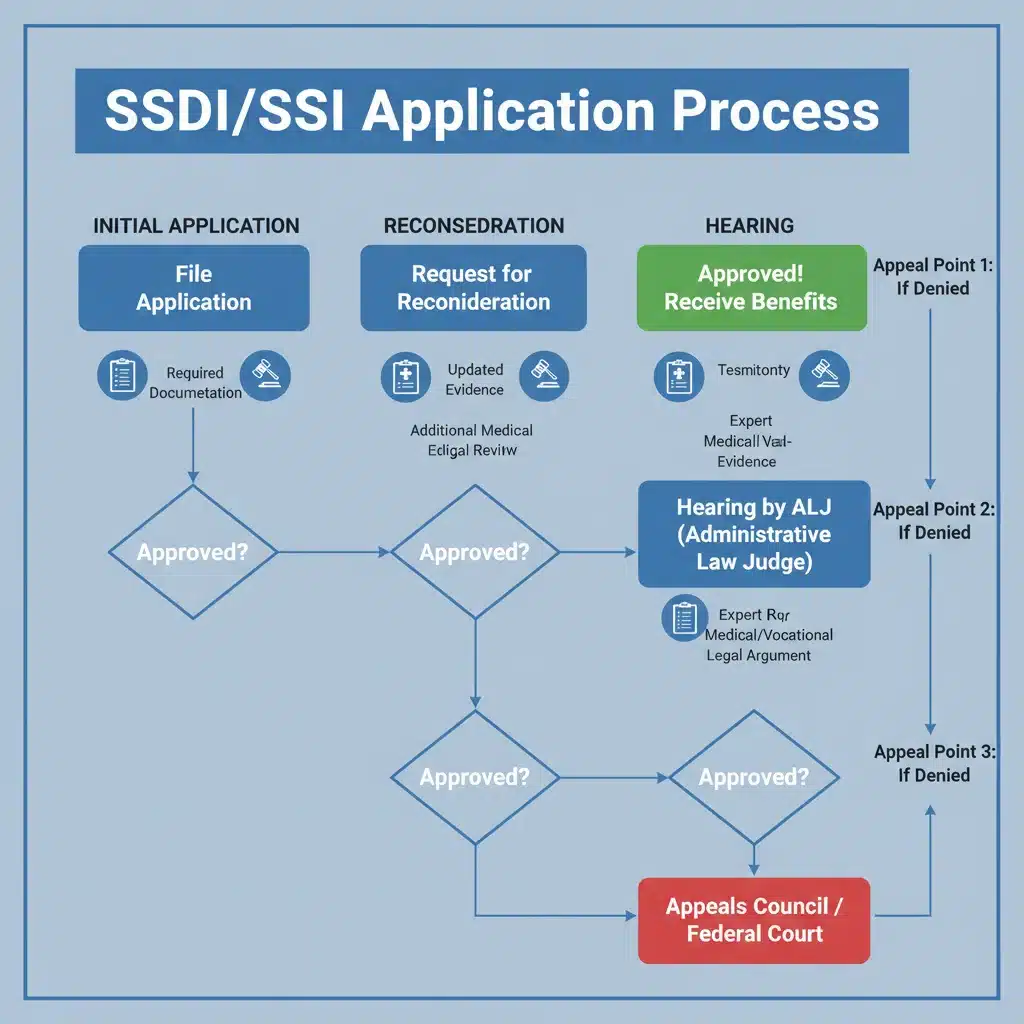
6. Don’t Give Up: The Appeals Process
Many initial applications for disability benefits 2026 are denied. This is a common occurrence, and it’s vital not to get discouraged. The appeals process has several levels:
- Reconsideration: Your case is reviewed by a different examiner.
- Hearing by an Administrative Law Judge (ALJ): If reconsideration is denied, you can request a hearing before an ALJ. This is often where applicants have the best chance of approval, especially with legal representation.
- Appeals Council Review: If the ALJ denies your claim, you can ask the Appeals Council to review the ALJ’s decision.
- Federal Court Review: As a last resort, you can file a lawsuit in federal district court.
Each stage has strict deadlines, so it’s essential to respond promptly. Missing a deadline can result in the permanent denial of your claim.
The Importance of Residual Functional Capacity (RFC)
Your Residual Functional Capacity (RFC) is a crucial assessment made by the SSA that determines what you can still do despite your limitations. It considers your physical and mental abilities. A well-documented RFC from your treating physician can significantly strengthen your case for disability benefits 2026.
- Physical RFC: Assesses your ability to sit, stand, walk, lift, carry, push, pull, stoop, crouch, reach, and handle.
- Mental RFC: Evaluates your ability to understand, remember, and carry out instructions; sustain concentration and pace; persist at tasks; interact appropriately with others; and adapt to changes in a work setting.
Encourage your doctors to complete an RFC form that clearly outlines your limitations. This objective assessment can be far more persuasive than general statements about your condition.
Common Pitfalls to Avoid in Your Application
Knowing what to avoid is just as important as knowing what to do. Here are common mistakes applicants make:
- Inconsistent Information: Providing conflicting information on different forms or to different medical providers.
- Gaps in Treatment: Lack of regular medical care suggests your condition is not severe or disabling enough to warrant consistent attention.
- Failure to Follow Prescribed Treatment: If you don’t follow your doctor’s orders, the SSA may view this as a lack of effort to improve your condition, potentially leading to denial.
- Ignoring SSA Communications: Failing to respond to requests for information from the SSA can lead to your application being closed.
- Exaggerating or Minimizing Symptoms: Both can harm your credibility. Be factual and consistent.
- Not Appealing a Denial: Many people give up after the first denial, missing out on their best chance at approval during the reconsideration or hearing stages.

The Role of Vocational Experts (VEs) and Medical Experts (MEs) in Hearings
If your case reaches an ALJ hearing, the judge may call upon a Vocational Expert (VE) and/or a Medical Expert (ME). Understanding their roles can help you prepare:
- Vocational Expert (VE): A VE testifies about job requirements, the transferability of skills, and whether jobs exist in the national economy that someone with your RFC could perform. Your attorney can cross-examine the VE to demonstrate that no suitable work exists given your limitations.
- Medical Expert (ME): An ME, usually a doctor, provides an impartial medical opinion based on your medical records and answers questions about your condition and its severity. Your attorney can also question the ME to clarify or challenge their testimony.
Preparing for these expert testimonies is another area where legal representation can be invaluable, as they can anticipate questions and prepare counter-arguments to strengthen your claim for disability benefits 2026.
Financial Planning During the Application Process
The application process for disability benefits 2026 can take months, or even years, especially if appeals are necessary. It’s vital to plan for this period:
- Savings: If possible, have some savings to cover living expenses.
- Short-Term Disability: Explore if you qualify for any short-term disability insurance through a former employer or private policy.
- Family and Community Support: Lean on your support network for assistance with finances, housing, or daily needs.
- State and Local Programs: Research state and local assistance programs for individuals with disabilities, which might offer temporary financial aid, food assistance, or housing support.
- Medicaid/Medicare: Understand that if you receive SSI, you typically qualify for Medicaid. If you receive SSDI, you become eligible for Medicare after a 24-month waiting period from your entitlement date.
Keeping Up with SSA Policy Changes for 2026
The SSA’s policies are subject to change, influenced by legislation, court decisions, and administrative reviews. To stay updated on disability benefits 2026:
- SSA Website: Regularly check the official Social Security Administration website (SSA.gov) for announcements, policy updates, and news releases.
- Legal News: Follow reputable legal news sources that cover Social Security law.
- Consult Professionals: Maintain communication with your disability attorney or advocate, as they are typically abreast of the latest policy shifts.
Proactive engagement with these resources ensures you are always working with the most current information, which is a significant advantage in securing your benefits.
Conclusion: Your Path to Approved Disability Benefits 2026
Applying for SSDI or SSI benefits is a challenging journey, but with careful preparation, thorough documentation, and perseverance, you can significantly improve your chances of approval. By focusing on comprehensive medical evidence, accurate application submission, understanding the SSA’s evaluation process, and considering professional legal assistance, you can aim to boost your approval odds for disability benefits 2026 by 25% or more.
Remember, the process is designed to be rigorous, but it is also designed to provide essential support to those who truly need it. Do not be discouraged by initial denials; instead, use them as opportunities to strengthen your case through the appeals process. With the right strategy and support, you can successfully navigate the complexities and secure the benefits you deserve.
Start preparing now, gather your records, consult with experts, and approach your application with diligence. Your future well-being depends on it.