SSI vs. SSDI 2026: Navigating Disability Benefits for Maximum Support

Anúncios
SSI vs. SSDI 2026: Navigating Disability Benefits for Maximum Support
Anúncios
For individuals facing a disability, understanding the landscape of available financial support can be a daunting task. The Social Security Administration (SSA) offers two primary programs: Supplemental Security Income (SSI) and Social Security Disability Insurance (SSDI). While both provide crucial aid to those unable to work due to a medical condition, they operate under fundamentally different rules and eligibility criteria. As we look towards 2026, it’s more important than ever to have a clear grasp of these distinctions to ensure you pursue the benefits that best suit your unique situation.
This comprehensive guide aims to demystify the complexities of SSI SSDI 2026, offering a detailed comparison, outlining eligibility requirements, discussing benefit structures, and providing practical advice for navigating the application process. Whether you’re just beginning your research or are deep into the application journey, this article will serve as an invaluable resource.
Understanding the Core Differences: SSI vs. SSDI Fundamentals
At their core, SSI and SSDI serve different populations and are funded through distinct mechanisms. Understanding these fundamental differences is the first step in determining which program, or potentially both, might be right for you. This section will break down the foundational aspects of SSI SSDI 2026.
Anúncios
Social Security Disability Insurance (SSDI): A Work-Based Benefit
SSDI is an insurance program. Think of it like any other insurance you might have, such as car or home insurance. You (or your employer) pay premiums in the form of Social Security taxes on your earnings during your working years. If you become disabled and are unable to work, SSDI acts as a safety net, providing benefits based on your past contributions to the Social Security system.
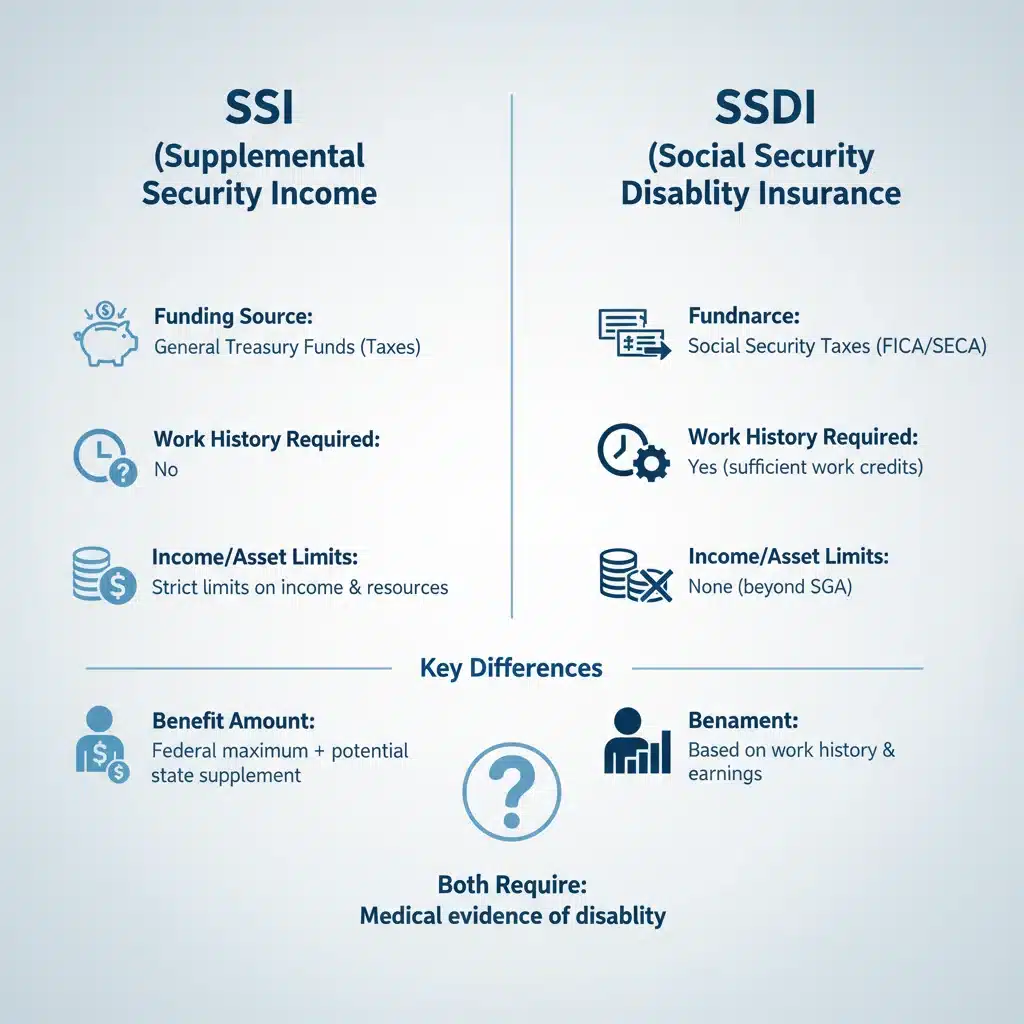
- Funding Source: Funded by Social Security taxes (FICA taxes) paid by workers, employers, and self-employed individuals.
- Eligibility: Primarily based on your work history and the payment of Social Security taxes. You must have accumulated a certain number of work credits, which are earned by working and paying Social Security taxes. The number of credits needed depends on your age when your disability began.
- Not Means-Tested: SSDI is not a needs-based program. Your income and assets (other than your ability to work) generally do not affect your eligibility or benefit amount.
- Benefit Amount: Your monthly benefit amount is calculated based on your average lifetime earnings on which you paid Social Security taxes. It is generally higher for individuals with a longer work history and higher earnings.
- Medicare Eligibility: After receiving SSDI benefits for 24 months, you typically become eligible for Medicare.
Supplemental Security Income (SSI): A Needs-Based Program
SSI, on the other hand, is a needs-based program designed to provide financial assistance to aged, blind, or disabled individuals who have limited income and resources. It is not dependent on your work history or contributions to Social Security taxes.
- Funding Source: Funded by general tax revenues, not Social Security taxes.
- Eligibility: Based on financial need. You must have very limited income and resources (assets). The specific limits are subject to change, and it’s crucial to check the most current guidelines for SSI SSDI 2026.
- Means-Tested: Strict income and asset limits apply. For 2026, these limits will likely be adjusted for inflation, but historically, they are quite low (e.g., $2,000 for an individual, $3,000 for a couple, excluding certain assets like your home and one car).
- Benefit Amount: The maximum federal SSI benefit is a standardized amount, though it can be reduced based on other income you receive. Some states also provide a supplemental payment.
- Medicaid Eligibility: In most states, receiving SSI automatically qualifies you for Medicaid, which provides health coverage.
Disability Definition: The Common Ground for SSI SSDI 2026
While their financial and work history requirements differ, both SSI and SSDI share the same strict definition of disability according to the Social Security Administration. To be considered disabled, you must meet the following criteria:
- You must be unable to engage in any substantial gainful activity (SGA) due to a medically determinable physical or mental impairment.
- Your impairment(s) must be expected to last for a continuous period of not less than 12 months or result in death.
The SSA does not consider partial disability or short-term disability. This ‘all or nothing’ approach means your condition must severely limit your ability to perform basic work activities, and there must be no other work you can reasonably perform given your age, education, and work experience.
Eligibility Requirements in Detail for SSI SSDI 2026
Navigating the specific eligibility requirements for SSI SSDI 2026 can be complex. Let’s delve deeper into what each program demands from applicants.
SSDI Eligibility: Work Credits and Disability Onset
To qualify for SSDI, you need to have worked long enough and recently enough under Social Security. This is measured in ‘work credits.’ You can earn up to four work credits each year. The amount of earnings required for one credit changes annually. For 2026, this amount will be adjusted, but it’s typically a relatively modest sum.
- How many credits do you need? The number of work credits required depends on your age when your disability began. Generally, you need 40 credits, with 20 of those earned in the 10 years immediately before your disability. However, younger workers may qualify with fewer credits. For example, if you become disabled before age 24, you might only need 6 credits earned in the 3-year period ending when your disability starts.
- Recent Work Test: This ensures that you have been a relatively recent contributor to the Social Security system. For most adults, this means working 5 out of the last 10 years before becoming disabled.
- Disability Onset Date: The SSA will determine your ‘established onset date’ (EOD), which is the date your disability began. This date is crucial for calculating your work credits and potential back pay.
SSI Eligibility: Income and Resource Limits
SSI eligibility is strictly tied to your financial situation. For SSI SSDI 2026, these limits will be updated, but the underlying principles remain constant.
- Income Limits: The SSA counts most types of income, including earned income (wages), unearned income (pensions, Social Security benefits, interest), and ‘in-kind’ income (food or shelter received for free or less than fair market value). Not all income is counted; certain amounts are excluded. For instance, a portion of earned income is disregarded to encourage work.
- Resource Limits: Resources are assets you own, such as cash, bank accounts, stocks, bonds, and property. For an individual, the resource limit is typically $2,000, and for a couple, it’s $3,000. However, certain assets are excluded, including:
- The home you live in.
- One vehicle, regardless of value, if used for transportation for you or a member of your household.
- Household goods and personal effects.
- Life insurance policies with a face value of $1,500 or less.
- Burial funds up to $1,500.
- Living Arrangements: Your living arrangements can impact your SSI benefit amount and eligibility, especially if you live with others who contribute to your household expenses.
Benefit Amounts and Healthcare Coverage for SSI SSDI 2026
The financial support and healthcare access provided by SSI and SSDI are critical considerations for applicants. Understanding how benefits are calculated and what healthcare options become available is essential when comparing SSI SSDI 2026 programs.
SSDI Benefit Amounts and Medicare
Your SSDI benefit amount is highly individualized. It’s based on your Average Indexed Monthly Earnings (AIME) over your working life. The more you earned and the longer you worked while paying Social Security taxes, the higher your potential monthly benefit will be. The SSA provides an online benefit calculator, and you can access your Social Security Statement for an estimate of your disability benefits.
- Maximum Benefit: There is a maximum monthly SSDI benefit, which is adjusted annually.
- Family Benefits: Certain family members, such as a spouse or dependent children, may also be eligible for benefits based on your work record.
- Medicare: One of the significant advantages of SSDI is eventual eligibility for Medicare. After receiving SSDI payments for 24 months (starting from your first month of entitlement, not necessarily your first payment), you will automatically be enrolled in Medicare Part A (hospital insurance) and Part B (medical insurance).
SSI Benefit Amounts and Medicaid
The maximum federal SSI benefit amount is standardized and is typically adjusted annually for cost-of-living increases (COLA). For 2026, this amount will be announced later, but it is designed to provide a basic level of income for essential needs.
- Federal Benefit Rate (FBR): This is the maximum federal SSI payment. Your actual payment may be less if you have other countable income.
- State Supplements: Many states provide an additional payment, known as a state supplementary payment, on top of the federal SSI benefit. The amount of this supplement varies significantly by state.
- Income Reductions: Your SSI benefit will be reduced dollar-for-dollar for most unearned income, and by about 50 cents for every dollar of earned income over a small exclusion amount.
- Medicaid: A major advantage of receiving SSI is automatic eligibility for Medicaid in most states. Medicaid provides comprehensive health coverage, often with minimal or no out-of-pocket costs, which can be a lifesaver for individuals with chronic medical conditions.
The Application Process for SSI SSDI 2026
The application process for both SSI and SSDI is rigorous and can be lengthy. It requires thorough documentation and often multiple levels of review. While the specific forms and timelines for SSI SSDI 2026 may see minor adjustments, the core steps remain consistent.
Steps to Apply: What to Expect
- Gather Documentation: This is perhaps the most critical step. You’ll need extensive medical records, including diagnoses, treatment histories, medication lists, and doctors’ notes. You’ll also need personal information (birth certificate, Social Security card), work history details (for SSDI), and financial information (for SSI).
- Submit Your Application: You can apply for disability benefits online for SSDI, by phone, or in person at your local Social Security office. For SSI, you can start the application online, but usually, a follow-up interview is required.
- Disability Determination Services (DDS): Once your application is submitted, it goes to a state agency called Disability Determination Services (DDS). DDS is responsible for making the medical determination of disability. They will review your medical records, and may contact your doctors or even send you for a consultative examination (CE) with one of their own doctors.
- The Five-Step Sequential Evaluation Process: The SSA uses a five-step process to evaluate disability claims:
- Are you engaging in Substantial Gainful Activity (SGA)? If yes, you are not disabled.
- Do you have a severe impairment? Your impairment must significantly limit your ability to do basic work activities.
- Does your impairment meet or equal a listing? The SSA has a list of impairments (the ‘Blue Book’) that are considered severe enough to prevent an individual from engaging in any SGA.
- Can you do your past relevant work? If your impairment does not meet a listing, the SSA will assess if you can still perform any of your past jobs.
- Can you do any other type of work? If you can’t do your past work, the SSA will consider your age, education, work experience, and residual functional capacity (what you can still do despite your limitations) to determine if there is any other type of work you can perform.
- Decision and Appeals: You will receive a decision letter. Unfortunately, many initial applications are denied. If denied, you have the right to appeal. The appeals process typically involves several stages: Reconsideration, Hearing by an Administrative Law Judge (ALJ), Appeals Council Review, and Federal Court Review.

Concurrent Benefits: Can You Receive Both SSI and SSDI in 2026?
Yes, it is possible for individuals to receive both SSI and SSDI benefits concurrently. This often happens when a person qualifies for SSDI but their benefit amount is very low, falling below the federal SSI payment standard. In such cases, SSI can supplement the SSDI payment to bring the total benefit up to the SSI maximum, or close to it, depending on other countable income. This is often referred to as ‘concurrent benefits’.
If you believe you might qualify for concurrent benefits, it’s crucial to apply for both programs. The SSA will evaluate your eligibility for each program separately and then determine if you qualify for a combination of both to maximize your support.
Practical Considerations and Tips for SSI SSDI 2026 Applicants
Applying for disability benefits can be a long and stressful journey. Here are some practical tips to help you navigate the process for SSI SSDI 2026:
- Be Thorough with Medical Evidence: This cannot be stressed enough. The SSA primarily relies on objective medical evidence from treating physicians. Ensure your doctors regularly document your symptoms, diagnoses, treatments, limitations, and prognosis.
- Keep Detailed Records: Maintain copies of all medical records, correspondence with the SSA, and any forms you submit.
- Be Honest and Consistent: Provide consistent information across all forms and during any interviews. Inconsistencies can raise red flags.
- Seek Professional Help: Consider consulting with a disability attorney or advocate. They specialize in Social Security disability law, understand the nuances of the application and appeals process, and can significantly improve your chances of approval. They often work on a contingency basis, meaning they only get paid if you win your case.
- Don’t Give Up After a Denial: The majority of initial applications are denied. This is a common part of the process. If you receive a denial, appeal promptly within the 60-day timeframe.
- Understand the Waiting Periods: For SSDI, there is a five-month waiting period after your established onset date before you can begin receiving benefits. For SSI, payments typically begin in the month following the approval of your application.
- Report Changes: If you are approved for either SSI or SSDI, it is your responsibility to report any changes in your medical condition, work activity, income, resources, or living arrangements to the SSA. Failure to do so can result in overpayments and penalties.
What to Expect for SSI SSDI in 2026: Potential Changes and Updates
While the fundamental structures of SSI and SSDI are expected to remain consistent, certain aspects are subject to annual adjustments and potential legislative changes. When considering SSI SSDI 2026, keep the following in mind:
- Cost-of-Living Adjustments (COLA): Both the maximum federal SSI benefit and SSDI benefit amounts are typically adjusted annually based on the COLA to keep pace with inflation. These adjustments are usually announced in the fall of the preceding year.
- Income and Resource Limits: The income and resource limits for SSI are also subject to annual adjustments.
- Work Credit Requirements: The amount of earnings required to earn one Social Security work credit is adjusted each year.
- Legislative Discussions: Social Security programs are frequently part of national discussions regarding fiscal sustainability and potential reforms. While major overhauls are less common, it’s always wise to stay informed about any proposed legislative changes that could impact benefits for SSI SSDI 2026 and beyond. The SSA website (ssa.gov) is the most reliable source for official updates.
Conclusion: Making an Informed Choice for Your Future
Choosing between SSI and SSDI, or understanding if you qualify for both, is a critical decision that impacts your financial stability and access to healthcare. By understanding the distinct characteristics of each program – SSDI as an earned insurance benefit based on work history, and SSI as a needs-based safety net – you can approach the application process with greater clarity and confidence.
As you plan for SSI SSDI 2026, remember the importance of comprehensive medical documentation, diligent record-keeping, and the potential benefits of professional legal guidance. The path to securing disability benefits can be challenging, but with the right information and preparation, you can significantly improve your chances of receiving the support you need and deserve. Don’t hesitate to utilize the resources available through the Social Security Administration and seek expert advice to ensure you make the most informed choice for your future well-being.