ETFs in 2025: Sector-Specific vs. Broad Market Options

Anúncios
Understanding the nuances of ETFs 2025 comparison, including sector-specific and broad market options, is crucial for investors aiming to optimize their portfolios amidst evolving economic landscapes.
Anúncios
As we navigate the complexities of modern financial markets, the strategic use of Exchange-Traded Funds (ETFs) in 2025: A Comparison of Sector-Specific and Broad Market Options becomes increasingly vital for investors seeking both growth and stability. This exploration aims to dissect the core differences, advantages, and considerations involved in choosing between these two prominent ETF categories, empowering you to make informed decisions for your investment journey.
Understanding Exchange-Traded Funds (ETFs)
Exchange-Traded Funds, or ETFs, have revolutionized the investment landscape by offering a diversified, cost-effective, and flexible way to gain exposure to various asset classes. Unlike traditional mutual funds, ETFs trade like stocks on major exchanges throughout the day, providing liquidity and price transparency. They are essentially baskets of securities—stocks, bonds, commodities, or a mix—that track an underlying index, sector, commodity, or other assets.
Anúncios
The appeal of ETFs lies in their simplicity and accessibility. Investors can purchase or sell shares of an ETF with ease, often with lower expense ratios compared to actively managed funds. This makes them an attractive option for both novice and experienced investors looking to build a diversified portfolio without the complexities of individual stock picking. Their structure allows for broad market exposure or highly targeted investments, depending on the fund’s objective.
The Mechanics of ETFs
ETFs are created by large financial institutions, known as authorized participants, who buy the underlying assets and then create ETF shares. These shares are then sold to investors on the open market. This creation and redemption mechanism helps keep the ETF’s market price in line with its net asset value (NAV), preventing large premiums or discounts.
- Diversification: ETFs inherently offer diversification by holding multiple securities, spreading risk across various assets.
- Liquidity: Trading on exchanges, ETFs provide intraday liquidity, allowing investors to buy and sell throughout the trading day.
- Low Costs: Generally, ETFs have lower expense ratios than mutual funds, benefiting long-term returns.
- Transparency: Most ETFs disclose their holdings daily, providing investors with clear insight into what they own.
In essence, ETFs blend the advantages of stocks and mutual funds, offering diversification with the flexibility of stock trading. This combination has made them a cornerstone of many investment strategies, and their evolution continues to present new opportunities for investors in 2025 and beyond.
Sector-Specific ETFs: Focused Growth Potential
Sector-specific ETFs are designed to track and invest in companies within a particular industry or economic sector, such as technology, healthcare, energy, or consumer discretionary. These funds offer investors a targeted approach to capitalize on the growth potential of specific industries they believe will outperform the broader market. In 2025, as economic trends shift and innovation accelerates, identifying promising sectors becomes a key strategy for enhanced returns.
Investing in sector-specific ETFs requires a keen eye on market trends and a willingness to take on higher risk in exchange for potentially higher rewards. For instance, a booming technology sector could lead to significant gains for a tech-focused ETF, but a downturn in that same sector could result in substantial losses. This focused approach demands more active monitoring and strategic adjustment than a broad market approach.
Advantages of Sector-Specific ETFs
The primary advantage of sector-specific ETFs is their ability to provide concentrated exposure to industries poised for significant growth. This allows investors to align their portfolios with their economic outlook and capitalize on thematic trends.
- Targeted Exposure: Investors can focus on specific industries showing strong growth prospects or innovation.
- Capitalizing on Trends: Ideal for investors who want to benefit from specific economic or technological shifts.
- Diversification within a Sector: While focused, they still offer diversification within that chosen sector, reducing single-stock risk.
- Potential for High Returns: Successful bets on rising sectors can lead to superior returns compared to broad market indices.
However, the concentrated nature of these ETFs also implies higher volatility and risk. A single negative event or regulatory change within a specific industry can significantly impact the fund’s performance. Therefore, a careful analysis of the sector’s fundamentals, growth drivers, and competitive landscape is paramount before investing.
Broad Market ETFs: Diversification and Stability
Broad market ETFs, in contrast to their sector-specific counterparts, aim to replicate the performance of a wide cross-section of the market, such as the S&P 500, the total U.S. stock market, or even global equity markets. These funds offer extensive diversification, spreading investment across numerous companies and sectors, thereby reducing the impact of poor performance in any single company or industry. For many investors, especially those with a long-term horizon or a lower risk tolerance, broad market ETFs form the bedrock of their portfolios.
The philosophy behind broad market ETFs is rooted in the belief that over the long term, the overall market tends to grow, and attempting to consistently pick winning sectors or individual stocks is challenging. By investing in a broad market ETF, investors essentially bet on the entire economy’s growth, benefiting from the collective performance of a large number of companies. This approach minimizes the need for constant market timing or in-depth sector analysis.
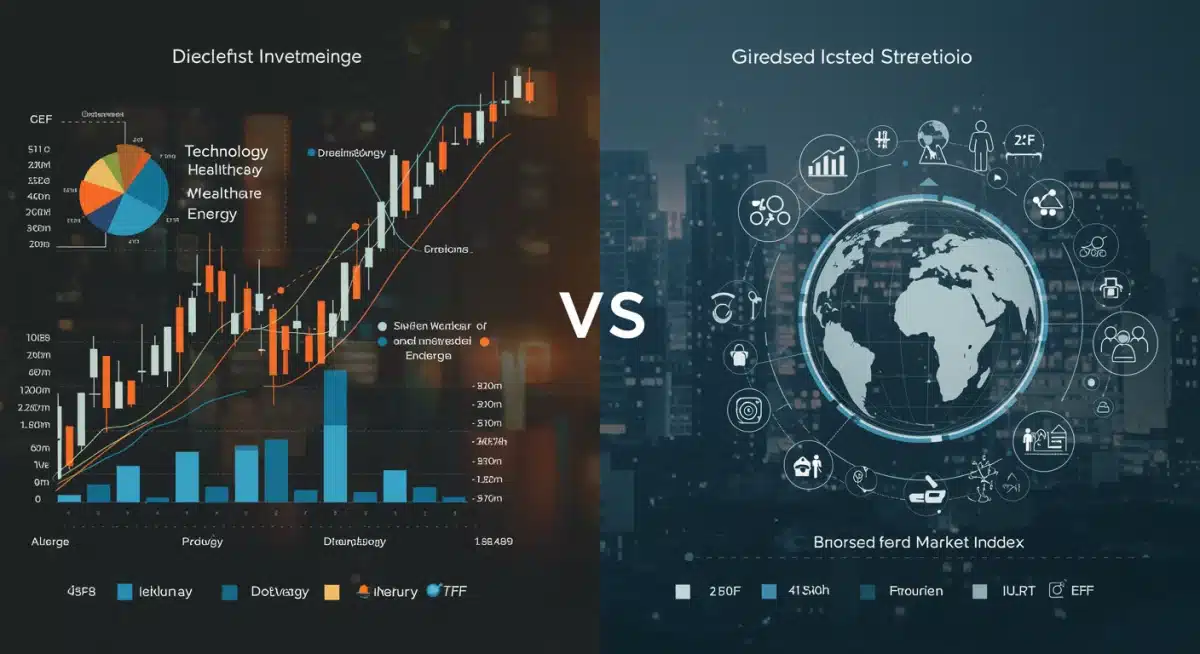
Broad market ETFs are often lauded for their simplicity and cost-effectiveness. They usually come with very low expense ratios, and their passive management style means less trading activity, which can lead to lower taxes on capital gains in taxable accounts. This makes them an excellent choice for core portfolio holdings, providing a stable foundation upon which more tactical investments can be built.
Benefits of Broad Market ETFs
The advantages of broad market ETFs are primarily centered around risk reduction and consistent, long-term growth potential. They offer a ‘set it and forget it’ approach for much of an investor’s portfolio.
- Extensive Diversification: Spreads risk across hundreds or thousands of companies and multiple sectors, significantly reducing volatility.
- Lower Risk: Less susceptible to the downturns of any single industry or company.
- Simplicity: Easy to understand and manage, suitable for passive investors.
- Consistent Performance: Tends to track the overall market’s growth, offering reliable long-term returns.
While broad market ETFs may not offer the explosive growth potential of a correctly timed sector bet, they provide a more predictable and less stressful investment experience, making them a cornerstone for many diversified portfolios in 2025.
Comparing Risk and Volatility in 2025
When considering ETFs 2025 comparison, specifically between sector-specific and broad market options, a crucial aspect to evaluate is their respective risk and volatility profiles. The investment landscape in 2025 continues to evolve with geopolitical shifts, technological advancements, and economic policy changes, all of which influence the risk associated with different ETF types.
Sector-specific ETFs, by their very nature, carry higher concentration risk. If the chosen sector experiences headwinds—be it regulatory challenges, technological disruption, or a shift in consumer demand—the ETF’s performance can suffer significantly. For example, an ETF focused solely on renewable energy might see substantial gains if government policies heavily favor green initiatives, but could face considerable losses if those policies are reversed or if fossil fuel prices drop unexpectedly. This inherent volatility means that investors in sector-specific ETFs must be prepared for larger price swings and have a strong conviction in their selected sector’s future.
Broad Market ETFs: A Buffer Against Volatility
Broad market ETFs, conversely, offer a significant buffer against such concentrated risks. By diversifying across numerous industries and companies, the impact of a downturn in any single sector is mitigated. For instance, if the technology sector falters, a broad market ETF tracking the S&P 500 would likely still benefit from the resilience and growth of other sectors like healthcare, consumer staples, or financials. This diversification leads to lower overall portfolio volatility, making them a more stable investment option.
- Sector-Specific Risk: Higher due to concentrated exposure; susceptible to industry-specific shocks.
- Broad Market Risk: Lower due to extensive diversification; less impacted by individual sector performance.
- Volatility: Sector ETFs typically exhibit higher volatility; broad market ETFs offer greater stability.
- Market Timing: More critical for sector ETFs to capture growth; less so for broad market ETFs.
In 2025, with potential for continued market fluctuations, understanding these risk differences is paramount. Investors must weigh their risk tolerance against their desire for potential high returns, deciding whether the focused growth of sector ETFs or the stability of broad market ETFs aligns best with their financial goals.
Strategic Allocation: Blending Both Approaches
For many investors, the optimal strategy in 2025 will not involve choosing exclusively between sector-specific and broad market ETFs, but rather finding a judicious blend of both. This approach, often referred to as a ‘core-satellite’ strategy, allows investors to achieve broad market exposure for stability while simultaneously pursuing higher growth opportunities in specific sectors.
A typical core-satellite portfolio would allocate a significant portion (e.g., 70-80%) to broad market ETFs, forming the ‘core’ of the portfolio. This core provides diversified exposure to the overall economic growth and acts as a stabilizing force. The remaining portion (e.g., 20-30%) would then be allocated to ‘satellite’ investments, which could include sector-specific ETFs. These satellites are chosen based on current market trends, personal conviction about certain industries, or a desire to overweight areas with strong growth potential.
Implementing a Core-Satellite Strategy
Implementing this strategy effectively requires a clear understanding of your financial goals, risk tolerance, and market outlook. For example, if you believe that artificial intelligence will be a dominant force in 2025, you might allocate a portion of your satellite investments to an AI-focused technology ETF, while maintaining a strong core in a total stock market ETF.
- Core Holdings: Primarily broad market ETFs for stability and long-term growth.
- Satellite Holdings: Sector-specific ETFs to capitalize on high-growth industries.
- Risk Management: Balances the higher risk of sector bets with the lower risk of broad market exposure.
- Flexibility: Allows for tactical adjustments to satellite holdings based on market conditions without disrupting the core.
This blended approach offers the best of both worlds: robust diversification and reduced overall portfolio risk from broad market exposure, coupled with the potential for enhanced returns through targeted investments in high-growth sectors. It is a sophisticated yet accessible strategy for navigating the investment landscape of 2025.
Considerations for 2025 Investment Decisions
As investors look to leverage Exchange-Traded Funds (ETFs) in 2025, several key considerations should guide their strategic decisions, particularly when comparing sector-specific and broad market options. The economic and technological landscape is constantly evolving, and a thoughtful approach is essential for optimizing portfolio performance and managing risk effectively.
Firstly, the global economic outlook for 2025 will play a significant role. Factors such as inflation trends, interest rate policies by central banks, geopolitical stability, and supply chain dynamics can all influence which sectors are likely to outperform. For instance, if inflation remains elevated, certain defensive sectors like consumer staples or utilities might offer more stability, while a period of strong economic growth could favor cyclical sectors like industrials or consumer discretionary.
Technological Advancements and Market Trends
Secondly, technological advancements continue to reshape industries at an unprecedented pace. Innovations in artificial intelligence, biotechnology, sustainable energy, and digital infrastructure are creating new growth opportunities but also posing challenges to traditional sectors. Investors considering sector-specific ETFs should conduct thorough due diligence to identify industries with sustainable competitive advantages and strong innovation pipelines.
- Economic Forecast: Assess global and domestic economic conditions impacting sector performance.
- Technological Disruption: Identify emergent technologies creating new growth sectors or disrupting existing ones.
- Regulatory Environment: Understand potential policy changes that could favor or hinder specific industries.
- Personal Risk Tolerance: Align investment choices with individual comfort levels regarding volatility and potential loss.
Finally, individual investor goals and risk tolerance must be paramount. A younger investor with a long time horizon might be more comfortable with a higher allocation to potentially volatile sector-specific ETFs, while an investor nearing retirement might prioritize the stability offered by broad market funds. Regular portfolio reviews and adjustments based on market conditions and personal circumstances will be crucial for successful ETF investing in 2025.
| Key Aspect | Description |
|---|---|
| Sector-Specific ETFs | Concentrated exposure to particular industries for targeted growth, higher risk. |
| Broad Market ETFs | Diversified exposure across many sectors and companies, lower risk, stable growth. |
| Risk & Volatility | Sector ETFs are more volatile; Broad Market ETFs offer stability. |
| Strategic Allocation | Core-satellite approach combines both for balanced growth and risk management. |
Frequently Asked Questions About ETFs in 2025
ETFs in 2025 offer diversification, lower expense ratios compared to mutual funds, and intraday liquidity. They allow investors to gain exposure to various asset classes or specific sectors efficiently, making them a flexible tool for portfolio construction amidst evolving market conditions.
Sector-specific ETFs target particular industries for concentrated growth, carrying higher risk and volatility. Broad market ETFs, conversely, track a wide range of companies across multiple sectors, offering extensive diversification, lower risk, and greater stability for long-term investors.
For long-term growth with reduced risk, broad market ETFs are generally preferred due to their inherent diversification. Sector-specific ETFs can offer higher returns if timed correctly but come with increased volatility and risk, making them more suitable for tactical allocations.
A ‘core-satellite’ strategy involves allocating a majority of your portfolio (the ‘core’) to stable, broad market ETFs for diversification, and a smaller portion (the ‘satellites’) to sector-specific ETFs to capitalize on high-growth opportunities within particular industries, balancing risk and reward.
Investors in 2025 should consider their personal risk tolerance, investment horizon, global economic outlook, technological advancements, and regulatory changes. These factors help determine the appropriate balance between sector-specific and broad market ETFs for their portfolio.
Conclusion
The choice between sector-specific and broad market ETFs in 2025 is not a matter of one being inherently superior to the other, but rather about aligning investment strategies with individual financial goals, risk tolerance, and market outlook. Broad market ETFs offer a robust foundation of diversification and stability, ideal for long-term growth and mitigating overall portfolio risk. Conversely, sector-specific ETFs provide the potential for amplified returns by capitalizing on high-growth industries, albeit with increased volatility. A balanced approach, such as the core-satellite strategy, often presents the most compelling solution, allowing investors to harness the collective strength of the market while strategically pursuing targeted opportunities. By carefully considering the evolving economic landscape and personal investment objectives, individuals can effectively leverage ETFs to build resilient and prosperous portfolios in the years to come.